How to Build a Cold Email Prospecting List for Any Target Market?
Want to learn how to expand your TAM and build a cold email prospecting list for any target market? Check out our in-depth guide with key best practices and workflows to help you do so.
Cleverviral
·
January 30, 2025
·
14 min
A cold email prospecting list is the holy grail of any outbound campaign, helping you both drive engagement and generate revenue. However, creating them can feel overwhelming, especially when you’re dealing with niche markets or scaling outreach for an unconventional product/service or offer.
This is because traditional methods of list-building often fall short – with manual searches, stale databases and generic personalization tools rarely yielding the hyper-targeted results modern businesses demand.
That’s where AI steps in as a game-changer, with tools like Clay helping automate and optimize your prospecting efforts & creating B2B contact lists that are precise, scalable and actionable.
Over the course of this article, we’ll explore the challenges of traditional, targeted list building and how you can instead opt for AI to build a high-performing cold email prospecting list for any business at scale.
So let’s dive right in!
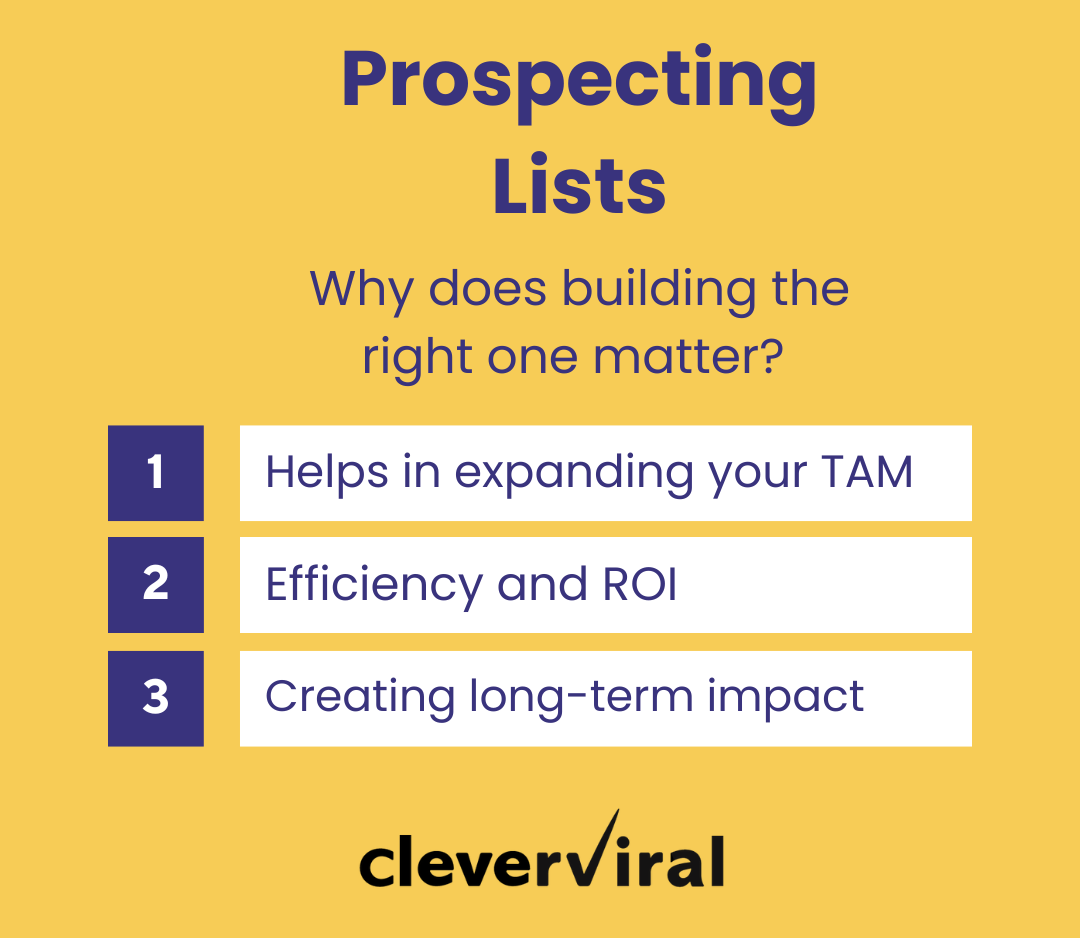
Why Building the Right Cold Email Prospecting List Matters?
There are several reasons why you should be looking to build a cold email prospecting list for your business. Some of them include:
1. TAM expansion
When building a TAM, businesses often aim for 100% market coverage. However, reality kicks in: achieving full market coverage is time-consuming and rarely cost-effective.
Now, while most businesses can gather 80% of their TAM using tools like LinkedIn, D7 Lead Finder, or Google Maps scrapers. However, capturing the remaining 20% requires accessing hard-to-find databases or unverified sources, often leading to diminishing returns.
Imagine you're targeting every HVAC company in the US. By scraping data from the above tools, you might capture about 140,000 companies. However, databases like Statista or the Bureau of Labor might suggest there are 250,000 companies.
The discrepancy arises due to inaccessible or unlisted companies. Realistically, going beyond 80% often involves diminishing returns—accessing outdated or irrelevant databases with low yield.
That’s where building a cold email prospecting list using tools like Apollo, Clay and Apify comes into the picture – helping you create target account lists that are both expansive and precise.
2. Efficiency and ROI
Another key reason to build a targeted, yet fully-expanded cold email prospecting list is the efficiency and ROI. It ensures efficient outreach by focusing on prospects most likely to convert, hence minimizing wasted time and resources (while also increasing revenue by a whopping 760%).
When teams work with a well-defined list aligned to their Ideal Customer Profile (ICP), they can tailor messaging and offers to address specific pain points, resulting in higher conversion rates.
3. Creating long-term impact
A well-maintained and accurate cold email prospecting list is more than a one-time tool—it’s a long-term asset that drives sustainable growth. Unlike ad-hoc outreach strategies, a strong database allows sales and marketing teams to nurture relationships across their Total Addressable Market (TAM) over time.
By building and regularly updating a target prospecting list, businesses can track engagement, revisit leads that didn’t convert initially, and refine targeting based on data insights.
This continuity creates a compounding effect: every outreach campaign adds value to the database by enriching it with information about prospect preferences, behaviors, and interactions.
As relationships develop, a cold email prospecting list evolves into a warm prospecting pipeline, reducing the time and effort required to convert leads.
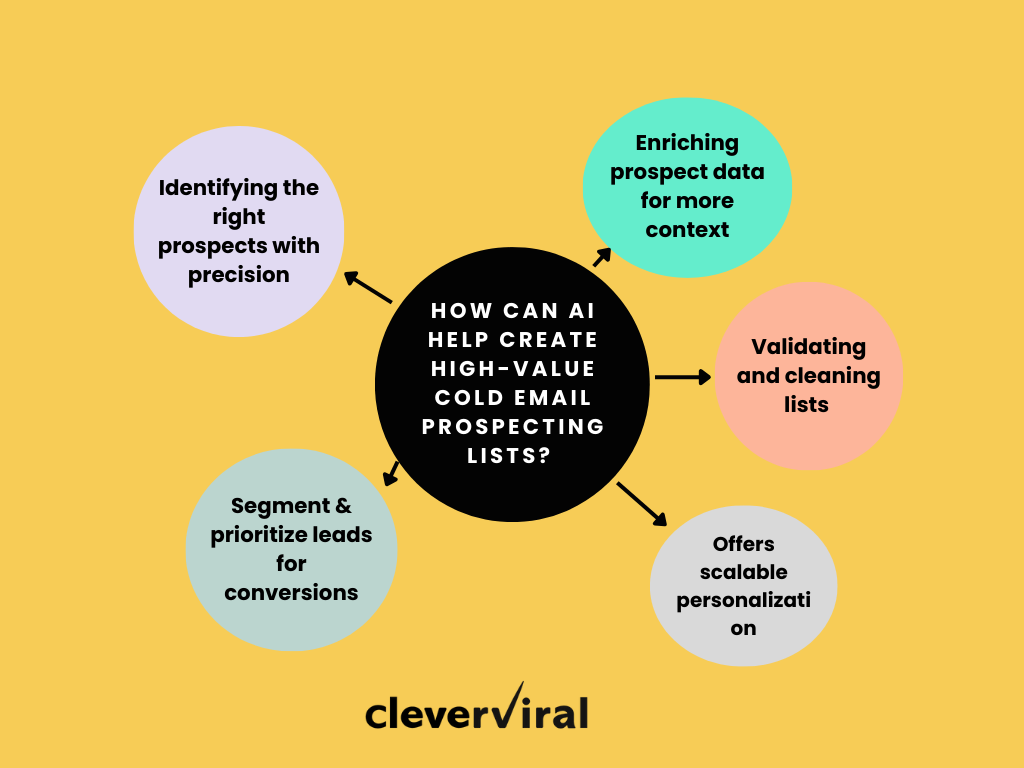
How can AI help create a high-value cold email prospecting list?
As stated previously, while 80% data is easy to find, it’s the 20% extra that counts. While databases have only so much prospect information, you can leverage AI tools to help you expand your TAM, and reach out to a higher number of prospects.
Given below, are some key ways AI can help create a high-value cold email prospecting list:
1. Identifying the right prospects with precision
One of the biggest challenges in preparing a highly-targeted cold email prospecting list is ensuring that you’re connecting with the right people. Traditional methods involve manual research or purchasing static lead lists, which are often outdated and lack precision.
AI solves this problem by analyzing vast datasets across multiple sources—social media, company databases, funding reports, job postings, and ad libraries—to identify businesses that fit your ideal customer profile (ICP).
2. Enriching prospecting data for a more complete picture
Just having a company name and email address isn’t enough for effective cold outreach. You need additional context, such as decision-maker contact details, revenue size, funding status, hiring trends, and advertising spend— to personalize your pitch effectively. AI-driven prospecting tools can enrich your lead list with this essential data in real-time.
For instance, AI can pull LinkedIn data to identify the key decision-makers within a company—whether it's the CMO, Head of Performance Marketing, or Founder. Additionally, AI-powered platforms like Clay or Apollo.io can append social profiles, recent news mentions, or even product launches related to a company.
This allows you to craft hyper-relevant cold emails, instead of sending a generic message. Such level of personalization, made possible by AI – dramatically increases the reply rates & helps build meaningful relationships with potential clients.
3. Validating & cleaning lists for better deliverability
One of the biggest killers of cold email campaigns is poor email deliverability. If your emails bounce or land in spam, your domain reputation suffers, leading to lower engagement rates over time. AI-powered email validation tools help eliminate bad leads before you even send an email.
AI tools like NeverBounce, ZeroBounce, or Instantly.ai check email addresses in real-time to remove:
Spam traps that hurt your sender score, among others.
By cleaning your cold email prospecting list, AI ensures that your emails actually land in inboxes, reducing bounce rates and improving overall email sender reputation.
This further translates into higher open rates and better long-term deliverability for your cold outreach campaigns.
4. Offers scalable personalization
Personalization is the key to getting responses, but doing it manually for hundreds of leads is nearly impossible. AI automates personalization by dynamically generating email intros, subject lines, and body text based on a prospect’s specific business activity, interests, and needs.
For example, AI can analyze:
A company's recent LinkedIn posts and mention them in your email.
A business's Facebook ad creatives and suggest improvements.
A company's Glassdoor reviews to highlight pain points in hiring (if offering recruitment solutions).
Using AI-powered tools like Clay, Lavender, or SmartWriter, you can generate hundreds of unique, high-quality emails in minutes
5. Segment & prioritize leads for higher conversions
Not all leads are equally valuable. AI helps you prioritize leads based on intent signals, engagement history, and likelihood to convert. Instead of reaching out to everyone on your list, AI assigns lead scores based on real-time data, ensuring you focus on the most promising opportunities first.
For example, AI can:
Track engagement (e.g., has the prospect opened your previous emails multiple times?)
Monitor buying intent (e.g., has the company recently increased ad spend or hired a growth marketer?)
Identify warm leads (e.g., has the prospect visited your website after clicking on a previous email?).
By segmenting leads into high, medium, and low-priority categories, AI allows you to tailor your follow-up strategy—putting high-intent prospects into a high-touch follow-up sequence while keeping low-priority leads in an automated drip campaign.
Step-by-Step AI Workflow to Expand Your TAM & Build A High-Performing Cold Email Prospecting List
Now that we’ve explored the importance of AI for creating a cold email prospecting list, its crucial to understand how you can leverage the technology to expand your TAM and reach more prospects at scale.
Given below, is a stepwise AI-powered workflow to understand this better:
Step 1: Initial data prospecting
The first step towards building an expanded cold email prospecting list involves collecting initial data based on industry, company size and keywords. So for example, if you’re targeting CEOs in the banking industry, you can leverage the “Industry” filter in Apollo to add keywords like ‘banking’ and ‘finance’ that return a list of companies that you’d want to target.
To keep things simple, you can clean up the list by cross-referencing company types to exclude non-banking entities. You can also include additional filters to narrow down your search.
Step 2: Enriching the data with Clay
Now that you have a raw target account list from Apollo, you can push it into Clay for further enrichment. The tool pulls additional data from various sources like:
Company (and personal) social media profiles
SEO descriptions
And other online sources offering a fuller picture of each lead who’s part of your ICP.
For example, when searching marketing leaders at eCommerce companies using Webflow – you can leverage BuiltWith to filter out the prospective companies. Once you’ve done that, you can simply import the list into Apollo, and enrich it with company-specific data that can further be refined with Clay.
Step 3: Utilizing BuiltWith for tech-based targeting
In case you want to expand your cold email prospecting list or find companies based on the technologies used on their website, you can leverage the BuiltWith integration to find which companies in your TAM run a specific technology and then use those insights to add in your Apollo data set.
Now say you want to target eCommerce companies that use both Webflow & Shopify. You can simply leverage BuiltWith data to filter out companies by technology, and apply the “last detected date” to ensure only the latest information is being used to run your prospecting campaign.
Step 4: Using D7 for local business data
When building a cold email prospecting list, especially targeting local businesses – traditional sources like LinkedIn can turn up short. Small businesses (such as yoga studios, HVAC contractors and local restaurants) either don’t maintain a LinkedIn presence or have incomplete/unclaimed company pages.
This makes data sourcing difficult, especially when you’re relying solely on Apollo or LinkedIn databases.
To counter this, you can leverage the D7 Lead Finder and Apify’s Google Maps Scraper to collect the data. Here’s a quick overview of how you can expand your target prospecting list using D7 and the Apify scraper:
Start by extracting the data of local businesses (say yoga studios) in Apollo
Run a search in D7 lead finder for the specific business type or keyword (say – “Yoga studios in Florida”)
Once you’ve done that, you can use the Google Maps Scraper to capture additional businesses in other cities in the United States
To close it off, you can simply cross-check the results and remove any duplicate or irrelevant listings/businesses.
Once you have a refined list, you can use Clay to enrich the data with website details, social media profiles and other such information.
You can also run a people search for specific job titles or decision-makers you’re looking to target at these small businesses.
Step 5: Validate & deduplicate data
Building a cold email prospecting list is only half the battle—the real challenge is ensuring that the data is clean, accurate, and relevant. Without proper validation, businesses risk wasted outreach efforts, high email bounce rates, and poor engagement.
That’s why data validation and deduplication are critical steps before launching a campaign.
Even with advanced tools like Apollo, BuiltWith, and D7 Lead Finder, raw data can contain inaccuracies:
Outdated job roles: Contacts may have switched companies or been promoted.
Duplicate contacts: Multiple sources may return the same person under different formats.
Irrelevant businesses: Scraped data can include businesses that don’t fit your ICP.
By running collected data through Clay, you ensure that your B2B contact lists remain high-quality and actionable.
Best Practices to Expand Your TAM & Build High-Quality Cold Email Prospecting Lists
Now while defining your ICP and using data enrichment tools are some common practices to build a targeted account list, there are a few more things you can do to ensure you’ve a sizable TAM to play around with, including:
Leverage “dark-funnel prospecting”: Most companies focus only on explicit data—business directories, LinkedIn, or CRM records. But what about prospects who are actively searching for your solution but haven’t engaged yet?
You can leverage AI to monitor hiring signals and track competitor churn to identify which companies are ideally in the market looking for your solution.
Use AI-powered email pattern mapping: To build a high-quality cold email prospecting list, you can leverage the likes of Clay and Voila Norbert to analyze email structures for ‘hard-to-find’ contacts (like {first}@company.com or {first}. {lastname}@company.com) which can then be validated using SMTP pinging.
Use the 80/20 rule for prioritization: Lastly, while it's easy to capture 80% of your TAM, getting whole 100% is difficult and often unnecessary. If the likes of Google Maps, LinkedIn or Apollo don’t list certain companies – they might be too small, inactive or just low-quality leads in general.
To solve this, make sure you prioritize quality over quantity – since chasing the last 20% might require excessive effort for little to no return.
By leveraging these best practices, you can easily expand your cold email prospecting list and make sure you’re only targeting the most accurate, hyper-targeted and conversion-optimized leads for your product or service.
Scale Your TAM & Reach More People with Cleverviral!
Building an effective prospecting list for cold outreach presents several challenges, especially in niche markets. However, AI tools like Clay can help you overcome these obstacles, enabling you to expand your Total Addressable Market (TAM) and target a larger customer base. While it's possible to build these lists independently, the process can be complex and time-consuming.
Partnering with a list-building expert like Cleverviral allows you to focus on building relationships with your prospects and closing more deals. If this aligns with your goals, feel free to reach out to us at hi@cleverviral.co or fill out the form on our website.
Until then, happy prospecting!!
Free test campaign
Reading about outbound isn't running it. Want us to run yours?
Apply below. If we're a fit, we run a real pilot on your ICP and show you the actual replies before you commit to anything.