
Prospecting
5 Key Email Personalization Mistakes to Avoid When Cold Emailing
Check out our list of the key email personalization mistakes you need to avoid in order to get the most out of your cold email campaigns in 2025.
Check out our list of the key email personalization mistakes you need to avoid in order to get the most out of your cold email campaigns in 2025.
Email outreach is one of the most powerful tools in a marketer's arsenal, but email personalization mistakes can easily undermine its potential. Crafting personalized emails that resonate with the recipient is essential for boosting open rates, engagement, and ultimately, conversions.
However, even the best email marketers can fall into personalization pitfalls if they don’t approach their campaigns carefully.
In this article, we’ll explore the importance of email personalization, the common cold email personalization mistakes that often happen, and actionable strategies to avoid these errors.
So let’s dive in and ensure your next campaign avoids these costly mis-steps!
Before we dive into discussing the most common email personalization mistakes, it’s crucial to understand the importance of personalization as a cold emailer.
It’s 2025 – and personalization is no longer just customizing the {{first_name}}. With the spam filters & AI rocking the sales landscape in the last 2 years, it has become more about truly understanding your recipient’s pain points, preferences, triggers & behaviors.
To succeed with modern cold outreach, you need to dive deeper into the above reference points & use those insights to craft targeted, hyper-relevant messages that resonate on a personal level – thereby increasing the response rates & also the engagement.
On the flip side, email personalization mistakes can have the opposite effect—turning a promising email campaign into a disaster.
Overlooking even the most basic cold email personalization mistakes can have a ripple effect: leading to lower engagement, high bounce rates, and even getting your emails marked as spam.
In fact, as per HubSpot – 51% of people say they’ve unsubscribed from an email list because the content wasn’t relevant to them.
In addition to damaging your brand’s reputation, personalization errors can also waste time and resources. If your emails aren’t resonating with the right audience, you’re not only hurting your chances of conversion but also missing out on valuable opportunities for growth.
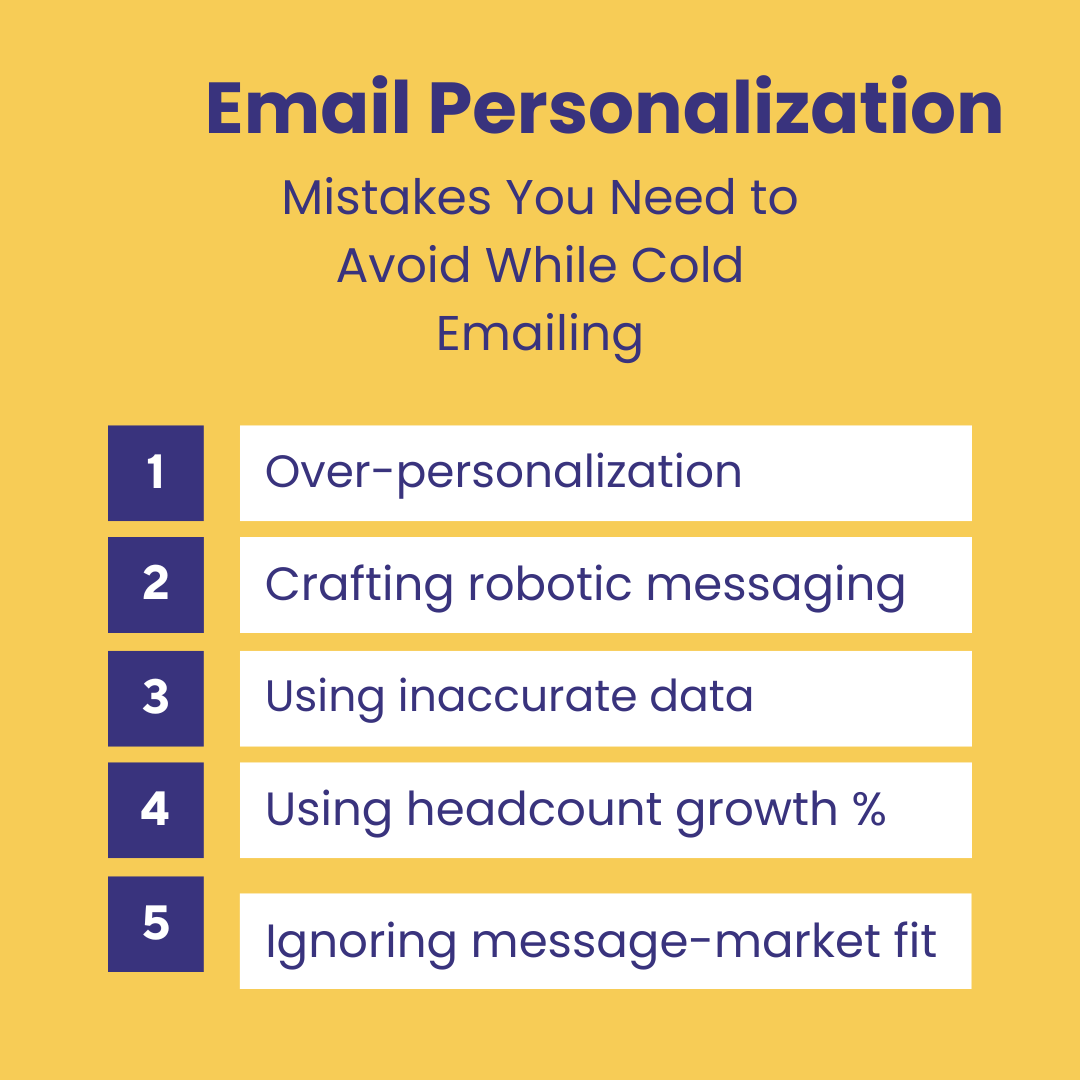
Now that we’ve explored the importance of personalization in cold emails, let’s jump into understanding the key email personalization challenges that you’re likely to face — and how you can avoid them.
So, while personalization and referencing a common point is often a great start – you must avoid over-personalizing the email with sensitive or irrelevant information.
We’ve seen cold emailers incorporate LinkedIn data to personalize their emails, using the prospect’s college and university’s reference. The idea is to say: “I know you didn’t go to Harvard to worry about xyz issues…” – assuming that prospect won’t want to deal with trivial problems like CRM data duplication and so on.
Now this could work for certain segments, but there’s a chance you might get negative responses, especially if the prospect isn’t from a top college. To them, it could come off as offensive.
The key learning here: Personalization is powerful — but context matters. Not every data point is fair game for personalization.
Educational background is personal, and in this case, it alienates more prospects than it engages.
According to McKinsey, 70% of consumers expect personalization to feel human and emotionally engaging, not automated. If AI-generated content feels robotic or out of place, it will fail to engage recipients.
An example of this is a campaign where we used the analogy that went something like: "It's like how Company X improved their conversion rates by 20%.” The idea was to showcase a relevant case study or example in a way that felt connected to the recipient's business.
Unfortunately, the approach fell flat, with the analogy failing to resonate with the prospects. It also showed no significant uptick in positive responses. As a salesperson, a key email personalization mistake to avoid is prioritizing cleverness over clarity. Unless your analogy ties directly to a pain point or ROI – it’s likely to be ignored.
Focus on what matters to your buyers – which is relevance over short-term gimmicks.
As per Instapage, the biggest challenges with personalization are gaining insight quickly enough (40%), having enough data (39%), and inaccurate data (38%). Using inaccurate data is a key email personalization mistake that can easily erode prospect trust and result in lower engagement.
We’ve seen companies use sources like SimilarWeb to personalize their emails – using its data to reference the prospect’s website traffic. While this initially seems like a great idea to showcase we did our research – it won’t work in the long run, simply because the tool’s traffic data isn’t 100% accurate. Even small discrepancies in the data made the email seem untrustworthy.
Prospects would either ignore the email or question the numbers, leading to a negative perception of your outreach.
According to Salesforce, 63% of sales teams that emphasize human-centered personalization outperform those that focus too heavily on raw data.
To that end, another popular email personalization mistake we see happening quite often is the use of the company's employee growth percentage in outbound emails.
With messages like: “Your team has grown by 21.6% in the past 6 months. That’s impressive!” – this approach feels robotic and overly data-driven.
Comparatively, if you can leverage scraped data as a filter and mention real people rather than percentages, it is more likely to get you a positive response.
Another key email personalization mistake we often see companies (especially service-based ones like SEO etc.) making is prioritising data sophistication over message-market fit.
We tried this approach for our SEO agency outreach, building AI-generated Google searches (like "personal injury lawyer Atlanta") and mapping where prospects ranked.
The emails would highlight where the company landed in SERPs. Despite the cleverness and technical effort, prospects didn’t reply, simply because the offer wasn’t resonating.
This however, can work well in other industries (like real estate), especially if you can subtly give them a glimpse of the visibility data.
The key takeaway here is that even with AI automation, the message-market is crucial for your outbound success. Being clever with scraping means nothing if the message doesn't hit a pain point.
To sum up, here are some actionable steps to avoid email personalization mistakes and ensure your cold emails resonate with your audience:
Review AI-generated content twice before you hit ‘send’ – to ensure it feels conversational and authentic.
If you're a B2B business looking to optimize your outbound sales strategy with more contextual, highly-relevant personalization (sans the aforementioned errors), it's a good idea to partner with an expert like Cleverviral, who can help you avoid these personalization pitfalls in a scalable manner.
To know more about how we can help, drop us a line on hi@cleverviral.co or simply book a call by filling the form on our website.
Until then, happy prospecting!
Apply below. If we're a fit, we run a real pilot on your ICP and show you the actual replies before you commit to anything.
Apply for a free test campaign →