AI Agents vs Traditional Automation: What's Better for Your Outbound?
Comparing the utility of AI agents vs traditional automation? Check out our detailed comparison of both outbound methods to choose the one that's best for your business.
Cleverviral
·
March 31, 2025
·
12 min
Traditional sales automation tools, like email sequences, CRM updates, and lead qualification workflows, have been around for years and have certainly proven their worth. However, the rise of AI agents—intelligent, self-learning tools that can adapt in real-time and make decisions based on data has completely shifted the game. These AI agents can do far more than just follow a set of instructions: right from engaging leads to personalizing outreach and even handling complex, dynamic conversations on their own.
As more companies explore the potential of AI agents vs traditional automation, the need to understand how these technologies compare becomes crucial.
In this article, we’ll dive into both options, highlighting their strengths and weaknesses, and offering insight into which one or combination of methods — can supercharge your outbound sales.
So let’s get started.
Understanding the AI Agents vs Traditional Automation Comparison — A Closer Look
Before comparing AI agents vs traditional automation, it’s crucial to understand what both of these methods entail. In simple terms, traditional sales automation includes tools and systems that carry out repetitive tasks with a set of predefined rules (think scheduling emails, nurturing leads & setting up autoresponders).
These tools are typically defined by a set of rules & work on a “set it and forget it” model.
Examples of traditional automation tools include:
Smartlead: A tool for automating cold email marketing campaigns.
HubSpot: Offers a range of automation features including lead nurturing workflows.
Salesforce: A CRM platform that automates data entry and prospect follow-up tasks.
These traditional automation tools usually offer a slew of benefits, such as:
Increased efficiency by automating routine tasks so sales teams can focus on high-value activities
It’s highly scalable and you can increase the volume of emails or messages without much extra effort
Helps automate tasks in a repeatable, consistent way – one that’s ideal for high-volume sales activities.
Unlike traditional automation, agent prospecting brings a new layer of intelligence to outbound sales. It’s not limited to simply following a fixed set of instructions; it learns, adapts, and evolves based on real-time data.
One of the standout features of Agentic AI is agentic prospecting—where the AI actively identifies the best leads and segments them based on behaviors, preferences, and past actions. The AI then tailors the outreach to these prospects, adjusting its approach as needed.
When comparing AI agents vs traditional automation in terms of benefits, agentic prospecting is known to offer benefits such as:
Increased adaptability, with AI agents learning from each interaction – thereby refining your strategies over time
AI agents can segment leads more accurately based on detailed behavioral data, ensuring outreach is always relevant
AI agents drive deeper interactions that feel more human-like, improving lead response rates.
The Core Differences: AI Agents vs Traditional Automation
Understanding the key differences between AI agents and traditional automation can help us clarify why businesses might choose one over the other.
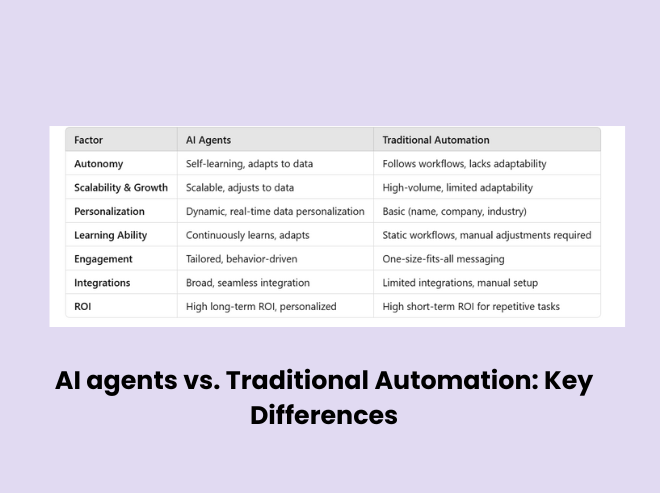
Here’s a breakdown of AI agents vs traditional automation, comparing them based on a few key characteristics:
1. Autonomy
The level of autonomy offered is a key consideration when comparing AI agents vs traditional automation. Unlike traditional sales automation tools, AI agents have more autonomy in the sense that the former need to be guided through the task with specific instructions/workflows, and they don’t operate beyond pre-programmed parameters.
Alternatively, AI agents offer increased levels of flexibility: analyzing data, understanding your business goals & making independent decisions based on real-time insights.
Let’s say you’re running an outbound sales campaign targeting mid-market SaaS companies. An AI agent with the goal of booking qualified meetings doesn't need to be told how to handle every unique situation.
For example, if a target prospect recently got promoted to VP of Marketing and just published a post about struggling to scale lead generation, the AI agent could:
Automatically detect the promotion and new title from LinkedIn.
Analyze the sentiment and pain points in the post.
Adjust its outreach messaging to reference the promotion, empathize with the challenge, and pitch a tailored solution.
Time the message based on when that person is most likely to engage (based on past interaction patterns).
Route the lead to the right rep or directly book a meeting — all without human involvement.
2. Scalability & Growth
When comparing AI agents vs traditional automation on the basis of scalability and growth offered, the former is more scalable, especially in terms of both volume & personalization. These agentic prospecting tools adjust to new data & continuously improve your targeting and messaging based on real-time insights.
On the other hand, traditional AI automation is ideal for high-volume, repetitive tasks but also lacks adaptability. Once the workflows are set, they’re usually run without any changes unless absolutely necessary.
3. Level of personalization
Traditional automation offers a basic level of personalization, often relying on simple data points like a prospect's first name, company, or industry. While this can be effective for creating a sense of individualized communication, the level of personalization is typically limited to static templates and predefined segments.
These campaigns are built around general assumptions about the prospect, which can make them feel impersonal or robotic, especially in competitive markets where prospects expect more relevant outreach.
Comparing AI agents vs traditional automation on the basis of personalization, the AI agents usually go deeper into personalizing your message, dynamically adjusting content based on data from real-time sources & even past interactions, thereby creating a more personalized message that gets you responses.
4. Learning ability
Another key point of difference in the AI agents vs traditional automation comparison is the learning ability or level of “intelligence” offered by both platforms/mediums.
While traditional automation follows predefined workflows and requires manual adjustments for optimization, AI agents continuously learn from each interaction, adapting their targeting, messaging, and engagement strategies in real-time.
This ability to evolve based on data allows AI agents to become more effective over time, making them far more adaptable and responsive than traditional automation, which remains static without intervention.
5. Engagement level
When it comes to optimizing your sales process for sales engagement & relationship management, traditional AI automation is ideal for scenarios where you have to deliver scalable, ‘one-size-fits-all’ messaging. This is ideal when you want to reach a large number of prospects, which is where the lack of personalization can lead to genetic, robotic interactions that don’t resonate.
Comparing AI agents vs traditional automation, the agentic AIs usually offer personalized engagement, adapting their messaging and interactions based on real-time data and prospect behavior.
This leads to a far more tailored interaction with your prospect, thereby increasing engagement and conversions for your automated sales efforts.
6. Integrations
When comparing AI agents vs traditional sales automation based on the integrations offered, the latter typically integrates with other popular CRMs and process automation tools (think HubSpot, Salesforce and so on) – mainly for data management & email automation. In addition, many of these tools require manual integration & might face challenges working across diverse systems.
Agentic AIs, however, offer a broader range of integrations, connecting seamlessly with CRMs, marketing platforms, and other AI-driven tools, such as chatbots and analytics platforms.
This allows these agentic prospecting tools to work more cohesively across different systems, offering a more interconnected approach to outbound sales.
7. Return on investment
When comparing AI agents vs traditional automation based on ROI, traditional automation can offer a high return in terms of cost efficiency for repetitive, high-volume tasks. It’s ideal for simple workflows like follow-ups and mass outreach, providing solid ROI by reducing manual labor and scaling processes.
However, AI agents provide a higher ROI in the long term due to their ability to personalize engagement and continuously improve based on data, leading to better conversion rates and more meaningful relationships with prospects.
While AI agents may require a higher initial investment, their ability to optimize strategies and increase engagement ultimately results in greater long-term returns.
The Future of Outbound: Blending AI Agents and Traditional Sales Automation
Instead of choosing between AI agents vs traditional automation, the future of outbound sales lies in seamlessly blending both. The key to optimizing sales efforts is leveraging the strengths of each approach: traditional automation for efficiency and scale, and AI agents for personalized, data-driven engagement.
By integrating them together, sales teams can drive greater productivity while maintaining meaningful interactions with prospects, ultimately boosting both efficiency and conversion rates.
If you’re a B2B business looking to leverage the combined value of AI agents & sales automation tools for your outbound, Cleverviral can help. We not only build AI agents specific to your use case, but can also set up automated workflows using sales automation tools at scale.
To know more about how we can help, drop us a line on hi@cleverviral.co or simply book a call on our website now!
Free test campaign
Reading about outbound isn't running it. Want us to run yours?
Apply below. If we're a fit, we run a real pilot on your ICP and show you the actual replies before you commit to anything.