Automate Data Scraping Using Clay and Apify: Quick Guide for Cold Outreach
Want to scale your outreach with new, freshly updated prospecting data? Learn how to automate data scraping and find any data for outreach using Clay and Apify.
Cleverviral
·
December 27, 2024
·
14 min
The success of any B2B outreach strategy hinges on one critical factor: quality data. In today’s competitive landscape, it’s not enough to have just a list of potential leads. Businesses need enriched, accurate, and actionable data to build personalized campaigns that resonate with their audience. However, traditional methods of data collection—like manual scraping—are time-consuming, error-prone, and ultimately limit scalability.
This is where AI data scraping tools like Clay and Apify step in. By automating the process, they allow businesses to access vast amounts of enriched, real-time data while minimizing manual effort (as evidenced by a 45% uptick in efficiency). They not only reduce operational inefficiencies but also enhance the quality of outreach, helping businesses connect with their ideal customers more effectively.
Over the course of this article, we’ll explore why one should automate data scraping for their cold outreach and how the Clay Apify integration can streamline workflows while maximizing efficiency.
So let’s get started!
5 Reasons to Automate Data Scraping with AI: An Overview
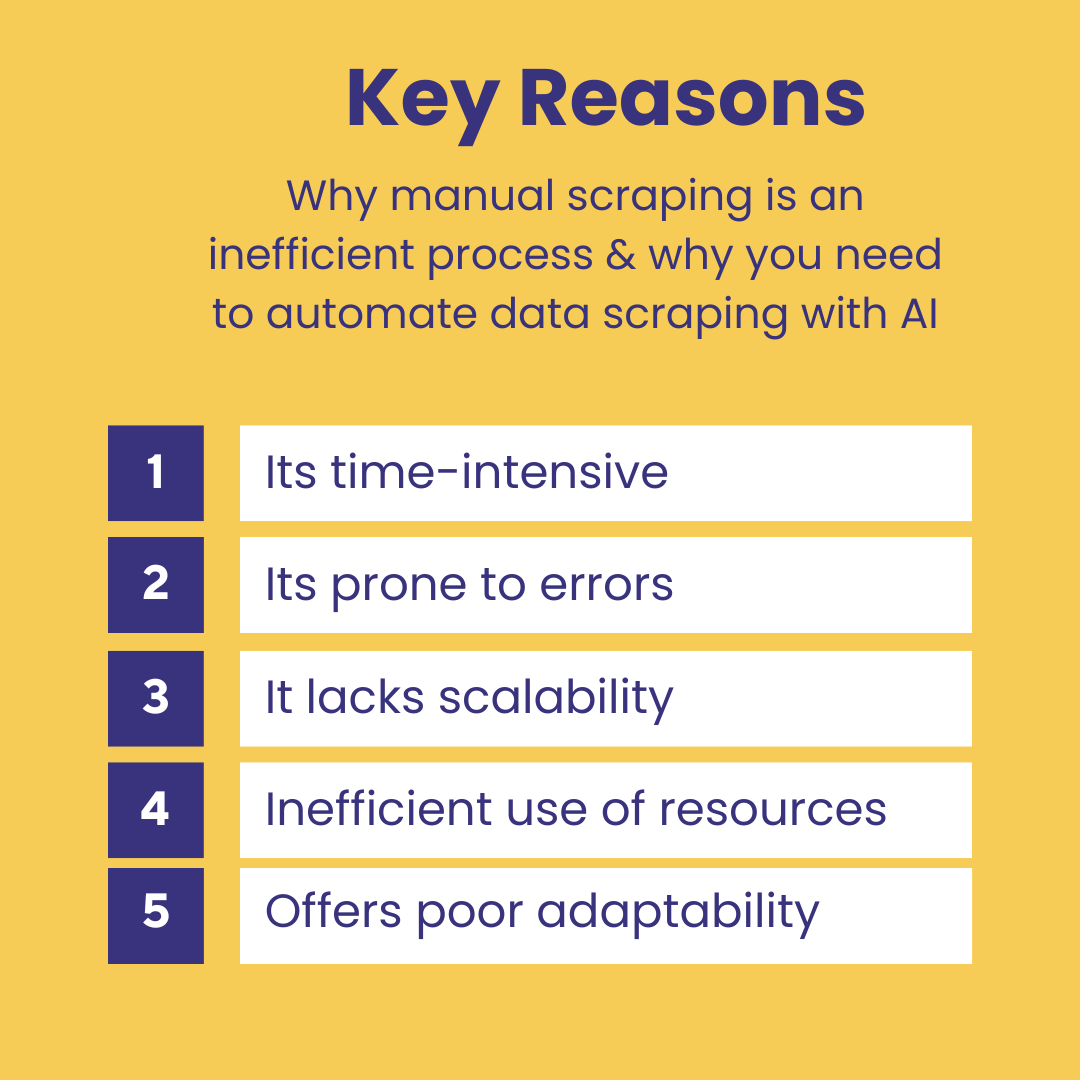
Data scraping is a critical cog in the wheel for B2B sales – especially when you look at elements like personalization and speed. However, manual data scraping has become increasingly outdated, particularly for cold email campaigns. Given below are some key reasons why manual data scraping is an unsustainable practice in the long run:
Time-Intensive: Manually gathering data from sources like LinkedIn, Google Maps, or company websites can take hours, if not days. This time drain limits the ability of sales teams to focus on core tasks like lead nurturing and closing deals. With sales reps spending only 31-32% of their time “actually selling”, it makes much more sense to automate data scraping using AI.
Prone to errors: Human error is an unavoidable downside of manual data collection. Mistyped information, overlooked fields, or reliance on outdated sources can lead to inaccuracies that compromise the success of your outreach efforts.
Lack of scalability: Another key reason you must automate data scraping is the lack of scalability manual scraping offers. While it may suffice for small-scale efforts, it becomes unsustainable when businesses need to scale their outreach to thousands of prospects across diverse industries or geographic regions.
Scaling manual scraping often means hiring additional personnel or outsourcing the task, which can strain budgets. Even with more resources, the pace of manual processes remains a significant barrier to meeting the demands of large-scale campaigns.
Inefficient use of resources: Sales teams are often overburdened with administrative tasks, and manual scraping only exacerbates this issue. Instead of dedicating their expertise to crafting compelling outreach strategies or closing deals, team members find themselves performing repetitive and mundane tasks.
Deciding to automate data scraping can help you allocate resources in a more meaningful way, increasing productivity and enabling sales teams to achieve their full potential.
Poor adaptability: Company profiles, job titles, and contact details can change overnight. Relying on static, manually scraped data leads to diminishing returns as the information quickly becomes outdated.
That’s where automating data scraping with AI proves to be a notch above, maintaining up-to-date and dynamic data sets that ensure your outreach remains relevant and highly-effective, even as the market changes.
Why Use Clay & Apify to Automate Data Scraping? – Key Reasons
Automating data scraping is vital for streamlining outreach workflows, and combining Clay and Apify creates a powerful system to achieve efficiency, scalability, and accuracy.
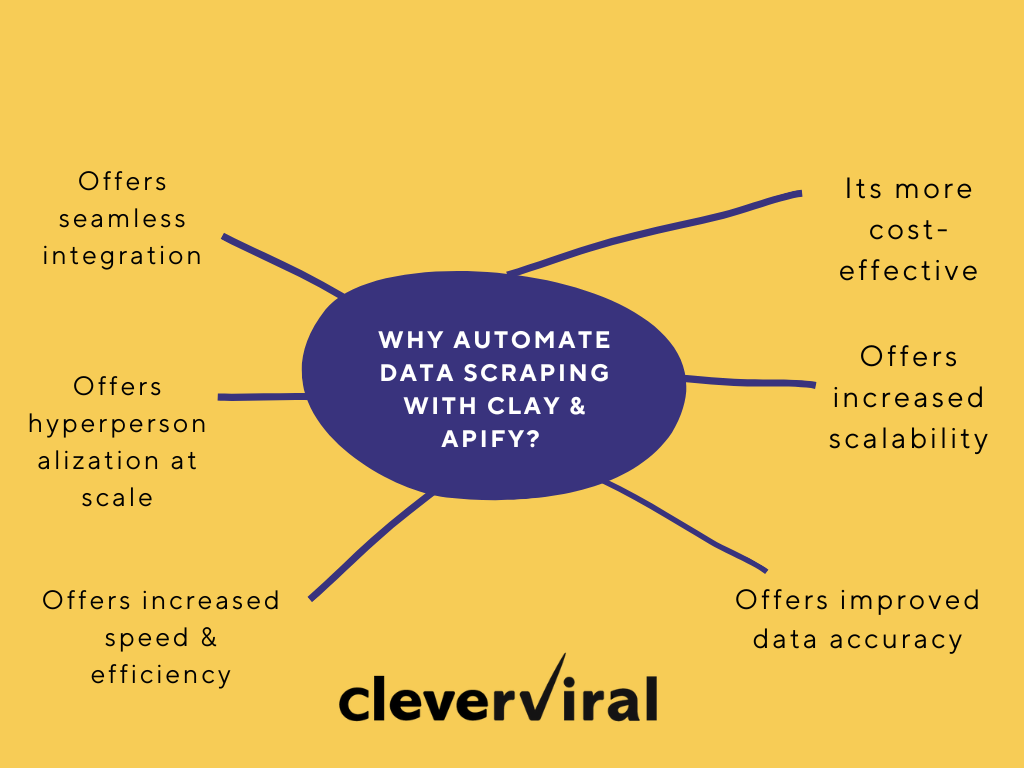
Here are some key reasons you should leverage Clay and Apify actor integrations to automate data scraping for your outreach:
1. Seamless integration
The Apify actor integration enables effortless scraping of raw data from platforms like LinkedIn, company websites, and job boards. Once data is collected, Clay enriches it with actionable insights, allowing users to build structured outreach workflows.
For example, Apify scrapes LinkedIn job postings, and Clay enriches them with decision-maker contact details, such as email addresses and phone numbers.
The Clay and Apify integration eliminates manual transfer of data between tools, ensuring consistency and reducing human errors. Teams can focus on crafting impactful campaigns rather than juggling tools and spreadsheets and save hours of manual labor per week.
2. Hyperpersonalization at scale
Personalization has become a cornerstone of successful B2B outreach. Using tools like Clay, Apify to automate data scraping empowers teams to achieve this at scale by scraping custom data points such as industry trends, hiring patterns, and even company size. This data is then seamlessly fed into Clay’s workflows, enabling the creation of hyper-personalized emails – achieving a 14% higher CTR and 10% better conversion rates compared to generic, one-size-fits all emails.
Thanks to AI web scraping, sales teams can then craft messages that directly address the recipient's unique challenges or opportunities.
3. Increased speed and efficiency
Speed and efficiency of processes is critical for any B2B sales operation. Using the likes of Clay and Apify to automate data scraping enables the sales team to focus on closing deals rather than managing backend operations.
Apify’s prebuilt actors are designed to scrape thousands of data points in minutes, while Clay automates related workflows, such as follow-ups and campaign execution. This eliminates the time-consuming nature of manual tasks like data collection and spreadsheet management – increasing the pace of time-to-market, giving your business a better competitive advantage.
4. Improved data accuracy
Accurate data is fundamental to effective outreach. Mistargeted campaigns not only waste time and resources but also damage credibility. By relying on AI data scraping, businesses can ensure their outreach efforts hit the right audience, and with the right message.
Apify ensures high-quality data scraping through its advanced algorithms, while Clay enriches and validates the data in real-time. This two-step process minimizes inaccuracies, such as outdated or duplicate information, which often plague manually collected datasets.
5. Increased scalability
Scaling lead generation efforts is often a bottleneck for growing businesses. Using Clay and Apify to automate data scraping and scale one’s lead generation efforts is a critical benefit of these tools.
While Apify collects massive amounts of data across platforms, Clay can automate the workflows and ensure you’re reaching out to the right prospects in a scalable, fully-automated manner. Apify simplifies this by collecting massive datasets across multiple platforms, while Clay automates workflows to handle outreach for thousands of prospects.
Together, they ensure that scaling doesn’t compromise the quality or personalization of campaigns. This scalability is particularly valuable for fast-growing startups or enterprises expanding into new markets since teams can manage larger campaigns without needing additional manpower or tools.
6. Cost-effectiveness
Adopting automation tools like Clay and Apify reduces operational costs by streamlining processes and cutting down on manual labor. Both of them offer affordable, subscription-based models – making them accessible to businesses of all sizes.
Moreover, automating data scraping with these tools reduces operational costs by streamlining mundane processes and cutting down on manual labor, all of it with minimal resource investment and improved ROI.
How to Automate Data Scraping with Clay & Apify? – Full AI Workflow
Now that we’ve explored the key benefits of automating data scraping with Clay and Apify, it's crucial to take a look at how we can leverage both tools to scrape and find ANY data to power your outreach.
Given below, is a stepwise workflow to help you automate data scraping with both the tools at scale:
1. Access Apify console
The first step to automate data scraping with AI involves creating an account on Apify. Once you’ve done that, you need to click ‘Go to Console’ and access the dashboard inside. You’ll find a couple different ‘actors’ or cloud-based mini programs that facilitate AI data scraping inside Apify. Then click the ‘Home’ option and search for the ‘Contact Details Scraper’ to run.
You’ll need to configure the tasks for each actor in order to scrape specific data sets. For example: you’d need to copy the LinkedIn search URL, paste it into the actor’s task setup and then customize the scraping parameters you want to utilize, such as job details, skills and more.
2. Use Clay to pull and enrich data
Once the Apify actors have been utilized to scrape the data, you can leverage Clay’s AI capabilities to pull in more data & transform it into useful insights for your outreach. To do so, click ‘Add Enrichment’ and choose the ‘Run Apify Actor’ option. While doing this, it's also crucial to choose the ‘Create task’ – which will create the task. You can also check this task (and others) under the ‘Saved tasks’ option.
Under the ‘Actors’ option in Apify, you’ll need to configure things like: ‘minimum pages per start URL’, ‘Stay within domain’ and ‘Probe frames’ among others to call the API via Clay row by row for the entire range of cells. While configuring the actors in Apify, go to the ‘JSON’ window and copy the code before pasting it inside Clay under the ‘Input Data’ while replacing the URL field with the dynamic token/column containing the website URL.
Make sure you test it out on the first few rows, with details like the company’s email, TikTok profile URL, Twitter and Facebook pages among others returned as output. Once you’ve done that, make sure to verify and clean the contact information to keep it ready for launch.
3. Automate and scale your workflows
In the third step to automate data scraping for your outreach, you’ll need to make sure that the scraped data is fresh and up-to-date. In order to do so, you can set up automated schedules (on a weekly or daily basis) or save the workflow as a template. Saving them as templates allows easy reuse during future campaigns & can be particularly helpful when ramping up high volumes of outreach.
For example, if you want to scrape LinkedIn job postings every Monday, the task will automatically update in Clay, enriching your prospect list without manual intervention.
4. Launch your outreach campaign
Once you’ve enriched the data in Clay, the next step is to use those personalized pieces of data in your outreach. Based on insights gathered (and the problem or pain point your product solves), you can then introduce different types of personalization.
Having run the personalization inside Clay using the prompts, you can then launch your outreach campaign inside tools like Smartlead, and scale them to the next level.
Based on insights gathered through Clay-Apify integration, you can also use the LinkedIn profile or phone numbers of the prospect to reach out to them across different channels.
Automate Data Scraping & Launch Hyperpersonalized Outreach Campaigns with Cleverviral
Using Clay and Apify together can maximize the success of your outreach, while also helping automate data scraping at scale. While Apify enables you to access fresh, updated data across the public web, Clay is crucial to transform it into a structured, actionable format.
If you’re a B2B business looking to scale your outbound efforts & need help crafting a scalable outbound strategy, partnering with the right growth partner (or agency) can be pivotal. We at Cleverviral can help you make the most of AI web scraping techniques, launching outbound campaigns that book meetings like clockwork.
To get in touch, simply drop us a line on hi@cleverviral.co or send-in your query through the form on our website.
Frequently Asked Questions
Can you automate data scraping?
Yes, you can automate data scraping with tools like Clay and Apify. The latter lets you extract raw data from websites (such as emails, phone numbers and LinkedIn profiles).
On the other hand, Clay can help you structure, organize and enrich the raw data collected into actionable workflows.
Is automated web scraping legal?
Yes, automating web scraping is a legal process, especially if you're scraping information from the public web.
It must however, be compliant with the website's terms of service, shouldn't bypass security protocols or misuse proprietary content.
Free POC
Reading about outbound isn't running it. Want us to run yours?
Apply below. If we're a fit, we run a real pilot on your ICP and show you the actual replies before you commit to anything.