
Prospecting
Clay vs Zoominfo – Which is Better For Your Outbound Prospecting?
Confused between choosing Clay vs Zoominfo? Check out our detailed comparison that will help you pick the right sales intelligence tool for your business.
Confused between choosing Clay vs Zoominfo? Check out our detailed comparison that will help you pick the right sales intelligence tool for your business.
In the modern business world, sales and marketing teams are fully aware of one undeniable truth: accurate, high-quality data is the backbone of any successful outbound prospecting strategy. In order to consistently hit their targets and close more deals, teams need reliable information to fuel their efforts.
Whether you’re generating leads, nurturing prospects, or customizing outreach, the quality of the data you're using is critical. Yet, sourcing this kind of high-quality data can feel like an uphill battle—there’s an overwhelming number of tools out there, and not all of them deliver what they promise.
This is where sales intelligence platforms like Clay and Zoominfo come into play. These platforms offer a unified system that gives businesses access to essential prospecting data, all while automating the sales process at scale.
Now, if you’ve ever found yourself wondering: “Clay vs Zoominfo – so which platform is really better for my prospecting?”; this article is what you need.
Over the next few paragraphs, we’ll dive deeper into the Clay vs Zoominfo comparison, objectively exploring the benefits, use cases & cons of both platforms. So let’s get started!
If you’re short on time, here’s a quick look at what both Clay and Zoominfo really are about:
1. Clay – Ideal for Personalization & Data Enrichment
Clay stands out for businesses seeking a platform that offers deep prospecting, scalable AI personalization, and data enrichment.
With access to over 100+ data sources, it helps you build highly personalized outreach at scale, leveraging AI-powered insights and creating tailored, unique experiences for your prospects.
2. Zoominfo – Comprehensive Database & Outreach Automation
On the other hand, Zoominfo is a robust, all-in-one sales intelligence tool that excels in providing access to a massive database of contacts and companies.
Beyond its database, the tool also offers website visitor tracking, multichannel outreach, and a suite of tools for sales engagement.
If you need comprehensive data enrichment, intent signals, and streamlined sales automation, Zoominfo could be your best bet.
Let’s compare both sales platforms further to help you make informed decisions.
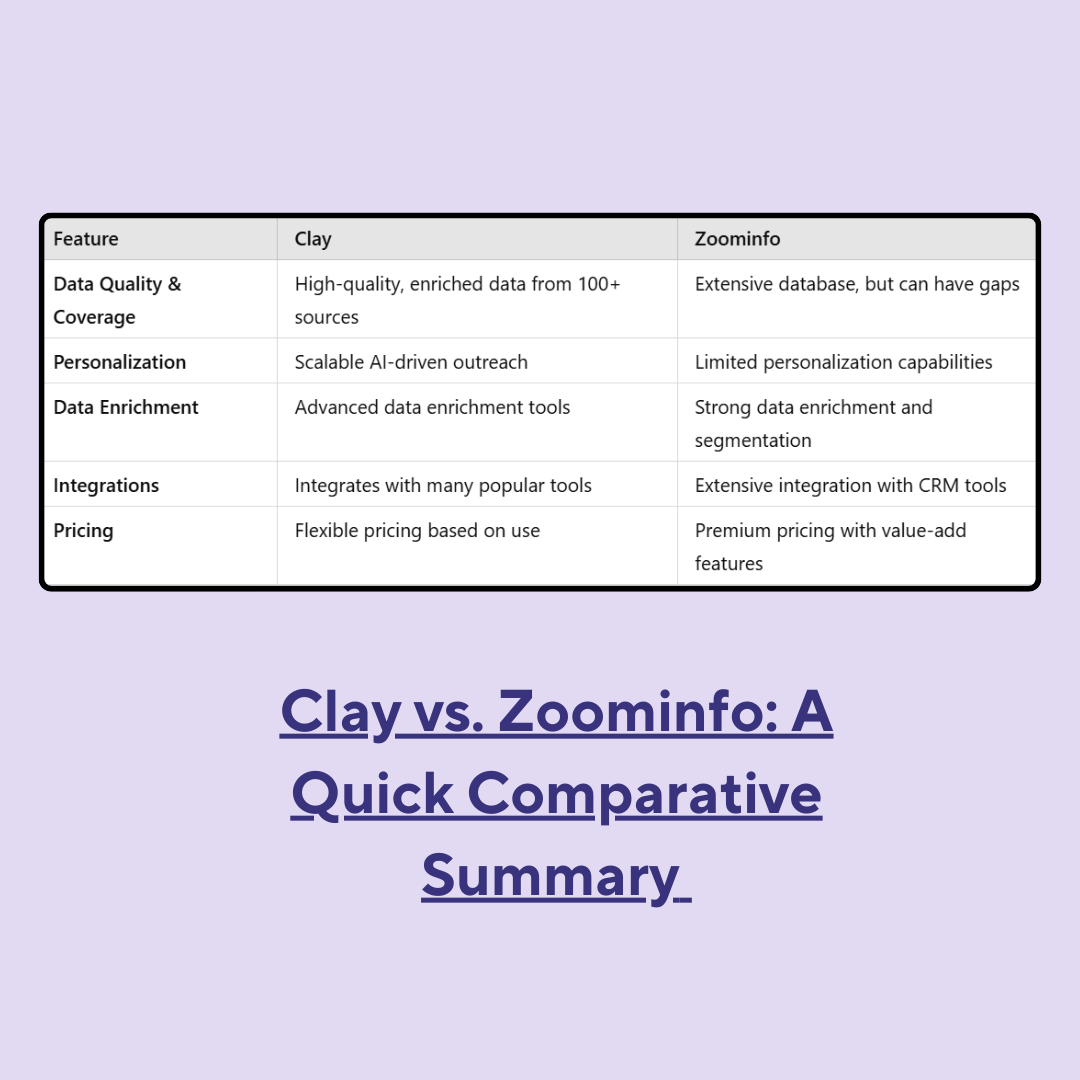
Now that we’ve got a basic overview of what to expect, it's time to dive deeper into the details.

Clay is an innovative sales intelligence platform that provides businesses with advanced prospecting capabilities, AI-driven data enrichment, and personalized outreach.
The data enrichment tool’s unique selling point lies in its ability to leverage AI to automate the enrichment process and ensure customization at scale.
Key features of Clay include:
Alternately….
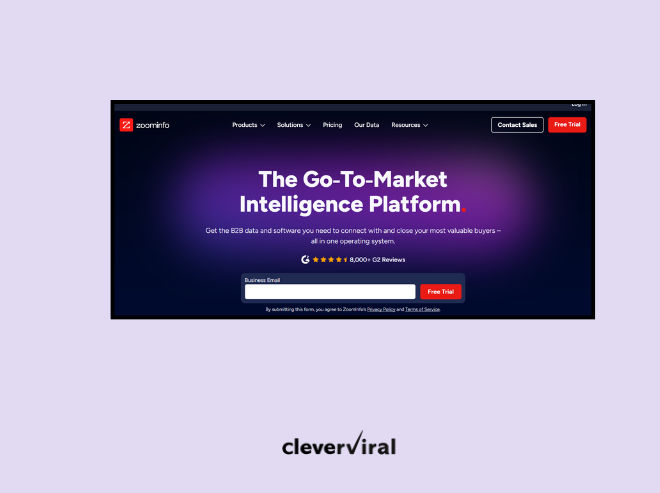
Zoominfo, on the other hand, is one of the largest and most established players in the sales intelligence space.
Known for its vast database of contacts and companies, Zoominfo delivers enriched data and insights about prospects, making it perfect for businesses looking for a comprehensive solution for their outbound efforts.
Key features of Zoominfo include:
Before diving deeper into the specifics of both platforms, it’s important to recognize that your choice between Clay vs Zoominfo depends on a few key factors:
In the next few paragraphs, we’ll dive deeper into the feature-specific comparison, helping you choose the right option between Clay vs Zoominfo for your business.
Both Clay and Zoominfo have several key features that help you bolster your B2B sales process. Although they’re similar, many of these features work differently.
Given below, is a detailed Clay vs Zoominfo comparison, based on several key criteria:
The foundation of any sales and marketing platform lies in its ability to provide quality data to enhance its users’ prospecting and outreach efforts. Clay and ZoomInfo offer a robust contact and company search feature, allowing users to access quality information about their ideal buyers and boosting their lead generation efforts.
High-quality B2B data is the cornerstone of any sales or marketing effort, and choosing the right tool (be it when you’re comparing Clay vs Zoominfo or any other platform) often depends on how well they enhance the users’ prospecting efforts.
To that end, both Clay and Zoominfo offer varying degrees of data quality & coverage.
While the former focuses on pulling quality, enriched data from 100 sources, the latter has a massive database of 50 million companies & contacts. Clay pulls real-time information from these sources, ensuring that you’re not dealing with issues like data decay & inaccuracy.
Alternatively, Zoominfo’s strength lies in the breadth of its coverage – with a large volume of prospecting data at your disposal.
That being said, many users have complained about the data quality being inconsistent, especially when it comes to small businesses or niche industries.
When it comes to user experience, Clay takes the lead with its easy-to-use interface. The platform is intuitive, with a focus on helping users navigate through prospecting and outreach quickly. Whether you’re an experienced sales rep or a new user, Clay’s interface allows you to get started with minimal training.
Zoominfo, while powerful, can be overwhelming for new users. The platform’s interface is packed with features, and while it provides a lot of data, the learning curve can be steep for new users.
Once you’ve identified which prospects to connect with, the next step is to reach out and engage with them. For this to happen, you’ll need to have their contact information – including their email address or phone number.
While Clay offers waterfall enrichment capabilities that pull information from 100+ data sources, Zoominfo also offers a B2B data enrichment feature that helps you enrich your prospecting list with contact information – constantly updating the lead list for the most accurate contact information.
When comparing Clay vs Zoominfo’s data enrichment capabilities, Zoominfo relies extensively on manual processes, which might not be a scalable option for fast-growing teams.
When comparing Clay vs Zoominfo, it's important to look at the various integrations and interoperability each of them offers.
Clay offers integration features with over 100+ data sources – making it a great choice for companies that already rely on other platforms like CRMs and email sending tools.
On the other hand, Zoominfo offers an extensive range of integrations with major CRMs like Salesforce & HubSpot, which makes it ideal for businesses already using a specific CRM, looking to streamline their workflows.
The level of sales engagement offered is another key consideration in the Clay vs Zoominfo comparison. It's important to note that Clay empowers teams to engage with prospects through AI-driven personalization, ensuring that every outreach feels targeted and relevant.
Whether it’s via email or social media, their tool allows for hyper-targeted communication. Zoominfo, on the other hand, offers multichannel sales engagement features, allowing businesses to engage prospects through email, phone, and social outreach.
This makes it ideal for teams who want to engage prospects across multiple touchpoints.
Lead qualification is a key component of B2B outreach, since it helps you identify which prospects to prioritize for outreach. When comparing Clay vs Zoominfo, you must look at the lead qualification features both offer.
Clay offers intent signals to time your outreach by tracking and alerting sales teams about the buying signals across the market. Using this insight, you can identify the most promising leads for you to reach out to.
Comparatively, Zoominfo’s advanced intent data algorithm helps you figure out the best leads to help boost your sales effort, leveraging features like “Buyer intent” and “Company signals” among others.
Both Clay and Zoominfo offer advanced search & filtering capabilities, with the latter edging Clay with robust filters that help users narrow down the prospects based on criteria like their job title, company size and industry among other variables. This feature is especially useful for businesses targeting specific niches.
Alternatively, Clay also offers robust search and filtering tools but focuses more on personalization and customized insights for each prospect – which might not be ideal for some users.
Now that we’ve completed the Clay vs Zoominfo comparison basis their features, let’s take a look at the difference in the pricing for both tools.
When it comes to Clay pricing plans, the platform offers several pricing tiers based on the usage & feature requirements. Their basic plan starts at $134/month, and goes up to $720/month for the pro plan.
What’s more, you can even get a custom price for your business, based on your requirements.
Zoominfo’s pricing is typically more expensive than Clay, with plans that start at a higher price point. They also offer different pricing structures based on features and usage.
You can visit their website and enter your requirements to get a custom quote for your business or use case.
When comparing Clay vs Zoominfo, it’s essential to dig beyond surface-level features and understand how each platform performs in real-world outbound prospecting workflows. Both platforms bring strong capabilities to the table—but their strengths and limitations often serve very different types of users.
Whether you're building hyper-personalized campaigns at scale (Clay) or managing a high-volume, database-first strategy (Zoominfo), your choice will ultimately depend on your team's needs, technical maturity, and sales process complexity.
Let’s break down the Clay vs Zoominfo comparison basis the pros and cons of each platform:
Both Clay and Zoominfo have their strengths and weaknesses, and the choice between them largely depends on your specific goals and business needs. If your focus is on AI-driven personalization and data enrichment across a variety of sources, Clay might be the better choice.
On the other hand, if you need a comprehensive sales solution with a massive database and robust multichannel outreach, Zoominfo may be the better fit.
In the end, choosing between Clay vs Zoominfo comes down to understanding your business requirements and the features that matter most to your team.
At Cleverviral, we help businesses strategically choose the right sales intelligence platform to scale their outbound engines.
If you’re looking to ramp up your outbound & get more meetings booked every month, reach out to us on hi@cleverviral.co or fill the form on our website with your requirements.
Apply below. If we're a fit, we run a real pilot on your ICP and show you the actual replies before you commit to anything.
Apply for a free POC →