How Is GTM Engineering Redefining the Future of Outbound?
GTM engineering is fast turning out to be the de-facto method top companies will use for outbound in the future. Learn everything you need to know about it to and make the switch seamlessly.
Cleverviral
·
February 12, 2025
·
14 min
Outbound sales as we know it is collapsing. The old-school tactics—buying lists from Apollo or ZoomInfo, blasting emails with basic personalization, and hoping for replies—are dying a slow, painful death.
For years, outbound sales relied on volume: hire more SDRs, send more emails, make more cold calls, and hope that something sticks. But that approach is no longer working.
Prospects are drowning in a crowded inbox, with companies leveraging cookie-cutter insights that DO NOT stand out.
AI-powered personalization at scale isn’t the solution – it’s just the same flawed process with a shinier wrapper.
If you’re still running outbound the old way (read: the 2015-2020 period), you’re already playing catch-up. Digging into our observations running outbound over the last 2 years, the real winners are swiftly moving to what we call “Go-to market or GTM engineering”.
Companies that invest in the transformation to low-volume, relevance-focused outbound will create long-term competitive advantages (and a stacked pipeline of leads), and those that don’t will keep brute-forcing outbound until the results deteriorate entirely.
Over the course of this article, we’ll break down everything you need to know about GTM engineering, and how companies can transition into this new model without the hiccups.
So let’s dive right in!
What is GTM Engineering?
In simple words, Go-to-Market or GTM Engineering is the process of systematically designing, building, and optimizing a company’s outbound sales motion using data, automation, AI-driven workflows, and intelligent market segmentation.
Unlike the traditional outbound sales model, where companies relied on static lead lists and brute-force outreach – GTM engineering turns your outbound sales process into an evolving system that improves over time.
So instead of a one-off campaign, GTM engineering uses a system that:
✅Continuously finds the right prospects based on real-time signals.
✅ Automates lead qualification and outreach workflows.
✅ Uses AI and multi-channel engagement (email, LinkedIn, ads) to boost response rates.
….. Ultimately creating a process that gets better over time.
Why Do We Need GTM Engineering for Outbound?
Outbound has traditionally been about access to contacts, not intelligence. A typical outbound motion looks something like this:
1️⃣ Buy a list of contacts from ZoomInfo, Apollo or any other database 2️⃣Apply basic filters (such as: job titles, industries and the prospective company’s revenue sizes). 3️⃣ Use shallow personalization (e.g., inserting the prospect’s name or company). 4️⃣ Send emails at scale and hope for replies.
This approach worked when inboxes were less cluttered. But today, it’s failing fast.
Here’s why:
✅ Rising costs, declining effectiveness:
A ZoomInfo license isn’t cheap. Neither is Apollo. Yet, response rates from list-based outbound have plummeted—because prospects are bombarded with generic outreach.
The more sales teams over-rely on automation, the more they contribute to email fatigue—pushing response rates even lower.
ESPs (Gmail, Outlook) continuously update spam filters, making it harder for automated outreach to land in inboxes.
If a company sends low-quality, low-response emails, its sender reputation tanks, making it even harder to reach prospects.
✅ No lasting competitive advantage:
Buying a lead list doesn’t differentiate a company—competitors have access to the same data.
The moment everyone is using the same tools, outbound turns into a race to the bottom.
The future of outbound won’t be anything like today – where AEs and SDRs craft each email manually.
With GTM engineering, we’ll see more and more companies adopting flexible structures where sellers become technical problem-solvers who:
✅Design highly-scalable, revenue-focused systems that help them reach a larger TAM
✅ Build and maintain automated workflows with tools like Clay and Make.com
✅ Handle complex relationships while automating the repetitive tasks
✅ And ensure seamless distribution of successful approaches across teams.
SDRs and AEs will focus more on combining the AI + human touch, while also creating automated data pipelines for deriving prospect information, and continuously monitoring & optimizing systems for improved performance.
So Where Does AI Automation Stand in This Scenario?
For companies following the traditional outbound model, they often see declining results & go: “Let’s just automate this with AI!” – rather than solving the problem, they’re utilizing AI to do more of what wasn’t working in the first place.
This usually includes:
→ Leverage automated personalization at scale
→ Using AI to write cold emails
→ Setting up mass LinkedIn outreach sequences
But here’s the problem: automating bad outbound doesn’t fix bad outbound.
In other words:
AI can write emails faster, but if the targeting is bad, it’s still just spam—only at scale.
AI can personalize based on first names and job titles, but real personalization requires deep market understanding.
That’s where GTM engineering comes in, leveraging real-time data, AI-driven insights, and automation to build an outbound motion that actually works. In a nutshell, it’ll be more about companies understanding and engaging their TAM in a way that creates compound advantages over time.
Key Components of GTM Engineering – How It Solves the Problems Associated with Traditional Outbound?
As stated previously, companies winning the outbound game in the next few years won’t be those with the largest SDR teams. Instead, it’ll be the ones who engineer their outbound motion with a strong “GTM foundation” – a structured system that multiplies over time.
This “foundation” consists of three layers:
1. The ‘Discovery’ Layer: Who Should You Target?
The first key layer in GTM engineering revolves around answering the question: "Who should I target?". Now, most companies target prospects too broadly—they filter for job titles and industry but don’t understand who actually needs their product and why.
The Discovery layer fixes this by focusing on deep segment-specific knowledge, identifying real buying triggers, and qualifying accounts based on behavioral data, not just static firmographics.
For example, instead of targeting all VPs of Sales, GTM engineering would prioritize VPs who’re actively hiring SDRs (a signal they need pipeline growth) or those who recently raised funding and are looking to expand their sales teams.
To build this layer, you’ll need workflows that:
Analyze past closed deals to identify high-value signals
Use AI-powered scrapers to track real-time prospect behavior
Segment ICPs dynamically, not just with firmographics
By doing this, sales teams ensure they’re always reaching out to the right accounts, at the right time.
2. The ‘Systems’ Layer: How Do You Operationalize Intelligence?
Once you’ve identified the right prospects, the next challenge is turning that intelligence into an efficient system. Many outbound teams fail because they either don’t have structured workflows or they rely on manual research and data entry, which slows everything down.
The ‘Systems’ layer in GTM engineering ensures that outbound sales doesn’t just collect data—it uses that data in a way that makes sales teams more efficient.
This process usually includes:
Constantly updating your lead lists with the right data (to avoid outdated prospect information )
Setting up AI workflows to qualify and enrich leads before outreach
Generating insights which are then integrated into the CRMs, sales automation tools and other databases.
Structuring this layer requires companies to:
Set up AI-driven scrapers to continuously track real-time buying signals
Ensure CRM automation syncs dynamically—so data isn’t just collected, it’s used effectively as well.
Structure the data in a way that fuels outbound workflows – so that every email, LinkedIn message or ad campaign is based on real engagement signals.
By building upon this layer, you can add more predictability and structure to the outreach, so that your reps can time their outreach to a point where prospects are most likely to be in the market.
3. The ‘Deployment’ Layer: How Do You Engage Prospects?
The third and most important aspect of the GTM engineering function is the deployment layer. Once you’ve the right people to target and a structured data foundation, outbound shifts from guesswork to more precise, systematic engagement.
In this layer, it’s all about:
Sending emails or messages that are direct, highly-relevant and well-timed
AI assisting personalization, while the human SDRs refine the messaging
Orchestrating outreach across channels like email, LinkedIn and paid ads among others.
To do this, you must:
Align your outreach timing with real-world triggers (hiring, funding, job changes)
Use multi-channel engagement through social media outreach and cold calling (not just cold email)
Test and refine your methods and approach based on the prospects’ response patterns.
All in all, these layers will be crucial as the industry moves towards more technical, systematic approaches to revenue and lead generation. AI-powered GTM engineers (or outbound agents) are what will drive this shift – helping customers get a bird’s eye view of what their GTM motions could look like in the near future.
How Does GTM Engineering Benefit Your Business?
There are several GTM engineering benefits that B2B companies enjoy, especially because they often lack the extensive internal resources or knowledge required to shift towards more agile and scalable GTM strategies.
Some of the key benefits include:
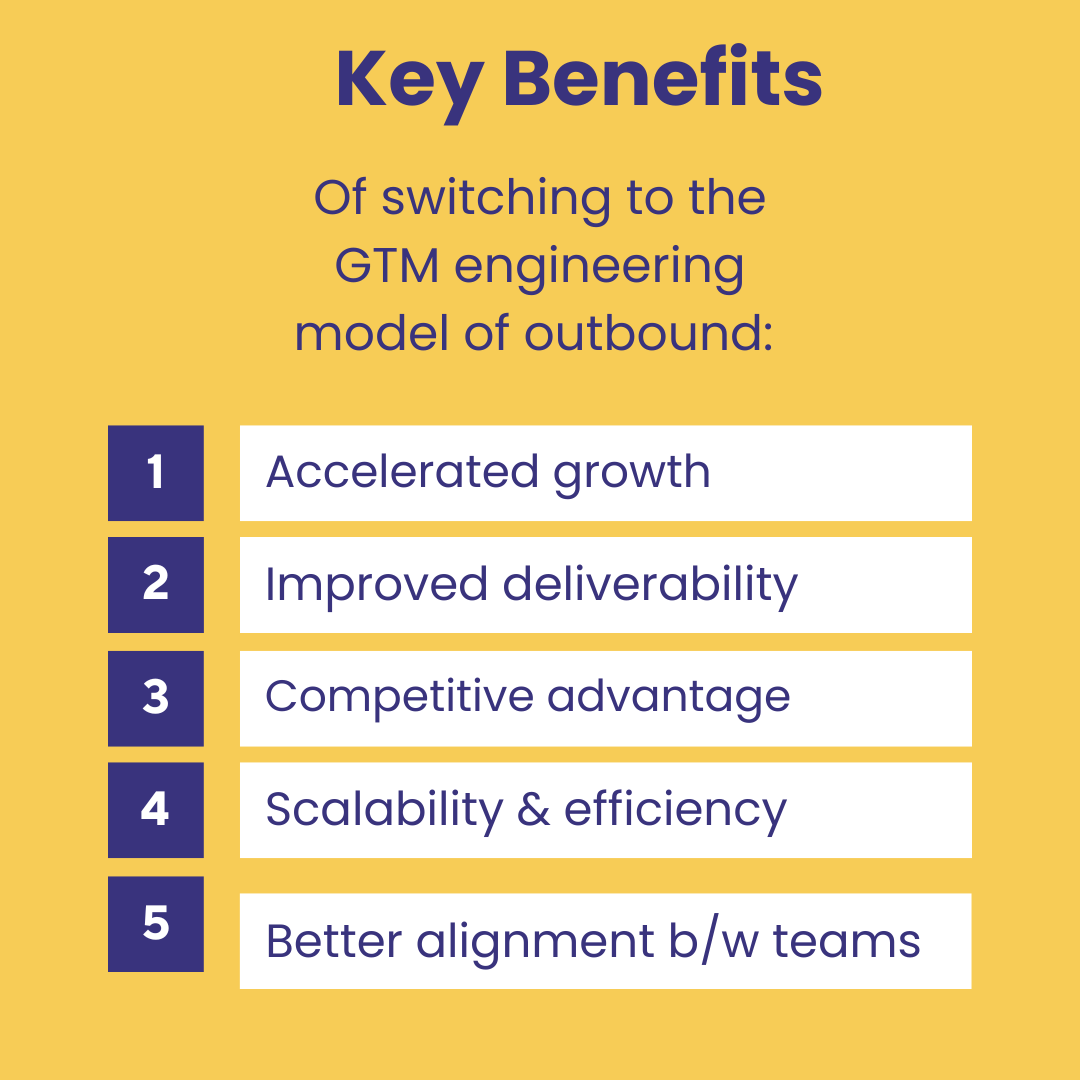
Accelerated growth: Faster iteration cycles would lead to quicker identification of what’s working and what isn’t.
Improved deliverability: Another key benefit of GTM engineering is improved deliverability, since sales teams can optimize their cold email infrastructure by implementing smart warmup techniques alongside domain and inbox rotation. This would lead to higher inbox placement, reduced spam and a significant increase in response rates.
Competitive advantage: Businesses that experiment with and refine their GTM motions are more likely to outperform those that rely on singular, static methods and techniques.
Scalability & efficiency: Unlike list-based outbound, where outreach is limited by manual processes, GTM Engineering automates and optimizes workflows. This allows sales teams to scale their efforts efficiently without sacrificing quality or personalization.
Better alignment between teams: GTM engineering can help bridge the gap between sales, marketing and RevOps functions – so that all key teams have a common goal and a unified approach to increase revenue generation.
These benefits highlight the true value of GTM engineering in the current B2B landscape, and how a structured, risk-free approach can help companies unlock long-term revenue potential.
How to Transition From Traditional Outbound to GTM Engineering?
Moving from traditional outbound to the GTM engineering model involves following a stepwise approach. If you’re still using outdated outbound methods—buying lead lists, blasting emails and following a “spray and pray” approach, you can change it up by working closely with a growth partner like Cleverviral, leveraging our expertise with building AI-powered GTM engineering agents and scalable outbound systems that help you generate demand more predictably.
To work with us, simply reach out on hi@cleverviral.co or fill in the contact form on our website!
Frequently Asked Questions
What is the role of a GTM engineer?
A GTM engineer designs and builds data-driven outbound systems that replace traditional list-based prospecting with AI automation, real-time intelligence, and scalable workflows. Instead of relying on static lead lists, they develop custom scrapers, enrichment tools, and dynamic segmentation models to identify high-intent prospects.
In addition, their role also focuses on optimizing the targeting and automating mundane tasks such as lead qualification & refining outbound strategies for the business.
With their expertise in GTM engineering, the goal of a GTM engineer is to create a self-improving system that delivers continuous revenue growth.
What are some key areas where GTM engineering could prove to be useful?
GTM engineering can be a super useful approach for B2B sales teams, integrating AI automation, advanced tools and continuous testing for optimizing revenue generation. Some key areas where it provides useful are:
- Using AI for lead scoring and qualification - Setting up automated outbound workflows and follow-up email sequences based on certain behavioral triggers - Making quick optimizations to campaigns & strategies based on data patterns & campaign performance.
Free POC
Reading about outbound isn't running it. Want us to run yours?
Apply below. If we're a fit, we run a real pilot on your ICP and show you the actual replies before you commit to anything.