Outbound Sales Outsourcing vs. In-House Sales Teams: How to Choose the Right One For Your B2B Business?
Discover how outbound sales outsourcing can drive results. Learn the benefits, challenges, and when to choose outsourcing vs in-house sales teams for growth.
Cleverviral
·
April 16, 2025
·
14 min
Building a high-performing sales engine is a top priority for growth-focused companies. Yet a critical question looms: do you build an internal team or leverage outbound sales outsourcing to accelerate your pipeline? This comprehensive guide explores the in house sales team vs outsourced sales team dilemma from all angles.
Over the course of the article, we’ll unpack insights, covering topics like:
Should you outsource sales or hire internally?
Can B2B sales be outsourced cheaply?
What are the advantages and disadvantages of outsourcing versus hiring an employee for B2B outbound sales?
By the end of this article, you’ll have better clarity on the pros & cons of both outbound sales outsourcing and in-house sales team development.
So let’s get started.
Why Is Outsourced Sales Development a Growing Trend?
The practice of outbound sales outsourcing (contracting external firms or SDR agencies to handle sales development) has surged in recent years.
As a result, they often turn to outbound sales outsourcing agencies rather than developing expertise in-house.
Increased opportunities for remote work: With the rise of remote and global work, geography matters less. Companies can tap talent anywhere. Sales development in 2025 is “less about the brand and more about what needs to be done and who can do it."
In other words, if an external specialist can perform the job effectively from afar, businesses are more open to that option.
Cost Pressures: Economic uncertainty and budget scrutiny have pushed firms to seek leaner ways to grow revenue. Outbound sales outsourcing can offer significant cost savings, with up to 40% reduction in costs compared to maintaining in-house teams
External providers often operate in lower-cost markets and spread resources across clients, yielding efficiency.
Faster Scaling: Outsourced sales development firms enable rapid scaling. Need to quickly increase outbound reach? It’s much faster to engage a ready-made external team than to recruit, hire, and train new internal reps.
This agility has appeal, especially when companies are expanding into new markets or testing campaigns. A survey by McKinsey found 48% of businesses outsource sales functions specifically to increase their geographic reach and scale into new regions faster.
Focus on Core Business: Handing off prospecting and lead generation to an outside team lets your internal sales and leadership focus on core activities like strategy, product, and closing deals.
Many firms see outbound sales outsourcing as a way to free up internal bandwidth. As a result, your internal headcount can remain lean while an external “engine” feeds your pipeline in the background.
Market Validation from Big Players: Even large enterprises leverage sales outsourcing vs in house sales team approaches in certain areas. For example, companies like Microsoft are now partnering with outsourced sales development agencies for scaling their outbound sales strategies.
When big names successfully use outsourced sales models, it further validates the approach and encourages others to consider it.
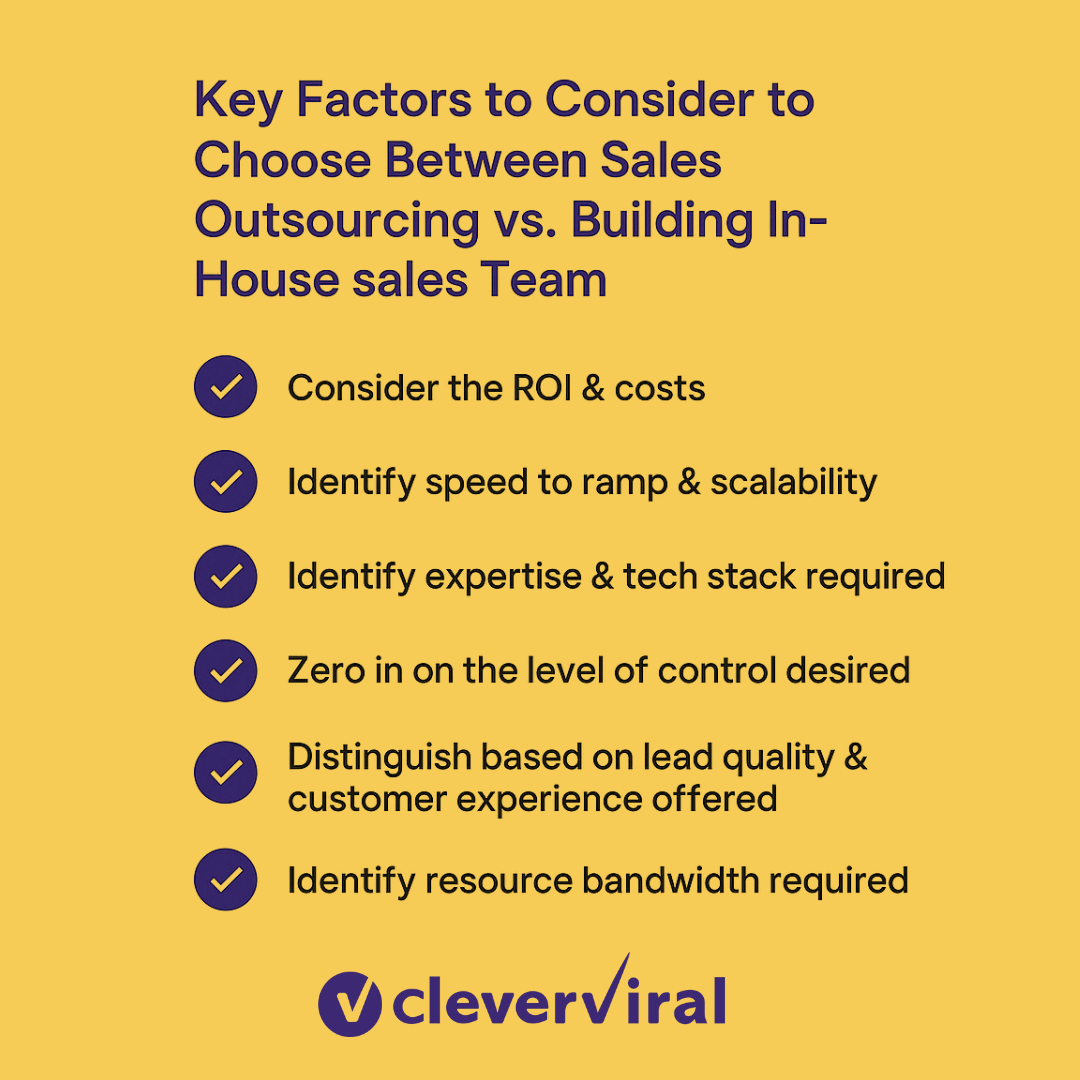
Sales Outsourcing vs In-House Sales Team: Key Factors to Consider
Deciding between outbound sales outsourcing vs in-house depends on your company’s needs.
Here’s a quick checklist to guide your decision:
Cost & ROI: In-house sales teams have higher fixed costs and require long-term investment. Outbound sales outsourcing can save you 30-40% in added costs, as you only pay for results, not infrastructure.
Speed to Ramp & Scalability: Building an in-house team requires time for recruitment, onboarding, and training, slowing down scaling. With outbound sales outsourcing, you can launch campaigns within weeks and scale easily.
Expertise & Tools: In-house teams develop deep product knowledge but require investment in tools and training. Outsourced sales development gives you access to sales experts and tools without the upfront costs.
Control & Alignment: In-house teams offer full control over strategy, messaging, and alignment with company culture. Outsourcing gives you less control but faster execution and flexibility.
Lead Quality & Customer Experience: In-house reps deliver more personalized outreach with a deeper understanding of the product. Outsourced teams can quickly fill the pipeline but may lack product expertise.
Resource Bandwidth: In-house teams require significant time for hiring, training, and management. Outbound sales outsourcing offloads this responsibility, freeing up internal resources for other priorities.
In summary, weigh these factors based on your unique context. If cost, speed & access to expertise are paramount – outsourced sales development is your go-to.
Alternatively, if brand alignment, product depth & control retention is a priority – one must opt for building an in-house sales team for their business.
When Should You Build An In-House Sales Team?
For startup founders and heads of sales at young companies, the outbound sales outsourcing vs in-house debate can be tricky. Startups often have limited resources and urgent growth targets, which makes outsourcing tempting.
But they also adhere to concepts like product-market fit and customer feedback, which argues for close-to-the-vest sales efforts.
Here are some considerations you should factor in while making a decision:
Stage matters: In the early stages (pre-product/market fit or post-launch), it’s usually best to keep sales in-house. Founders and early team members should be talking to customers directly. This helps refine your pitch and understand what resonates with customers.
Experienced founders often advise against outsourcing outbound sales too soon, as it’s a critical part of your strategy & one shouldn’t completely hand off such a critical learning opportunity at the start.
Once you have traction, outsourcing can fuel growth: Once your startup has traction, a clear ICP (ideal customer profile) and value prop; you have a playbook for outbound sales that an external team can follow.
It’s perfect for ramping up top-of-funnel activity quickly without needing a full internal team, buying you time & pipeline while you recruit AEs or bring SDRs in-house.
Trust but verify: If you decide to outsource sales development, due diligence is key. Not all sales agencies are created equal—some are great, others not so much. Talk to references, see how they train reps, and ensure they align with your brand.
Establish a tight feedback loop with weekly check-ins and shared dashboards to monitor quality and metrics. Treat outsourced reps as an extension of your team—invite them to product training or meetings.
You can also incentivize the lead gen agency based on pipeline value, not just meetings set.
Hybrid approaches for startups: A hybrid model works well for many startups. For example, keep one in-house salesperson to handle high-value prospects while outsourcing the cold outreach and appointment setting.
This helps you capture the best of both, helping you foster strategic alignment with the in-house rep, while outsourced reps generate the volume you need.
In summary, startups can trust outbound sales outsourcing as a growth lever, but it works best when you have clarity on your sales message and target, and when used as an augmentation of your efforts, not a replacement for understanding your customers.
Early on, do things that don’t scale (founder-led sales) to get the basics right; then consider outsourcing to scale those proven tactics.
Outbound Sales Outsourcing vs In-House Team: Pros and Cons
Now that we’ve explored the most likely factors to consider while choosing between outbound sales outsourcing vs in-house sales teams, it’s crucial to understand the pros and cons both methods offer.
Given below, is a fireside view of the same to help you make a more informed decision:
Pros of Outbound Sales Outsourcing:
Cost savings & flexibility: Outbound sales outsourcing generally costs lower than hiring a full internal team. You can engage an agency for a fraction of the cost of in-house headcount, while scaling your requirements up & down as per the situation.
This flexibility can save money during slow periods and quickly ramp up during growth spurts without long-term commitments.
Faster time-to-market: An outsourced team can start producing outreach and leads in a matter of weeks. They come pre-trained, with established processes.
This rapid deployment means you get a pipeline faster, which is crucial if you need quick market penetration or have limited time to show results.
Access to expertise and technology: Outbound sales outsourcing companies often employ specialists – people who only do SDR/BDR work and are experts in prospecting, cold emailing, cold calling, and using sales tech.
You tap into that accumulated expertise and also gain access to their toolset (sequencing software, databases, analytics).
Many providers tout their advanced tools and data capabilities as part of the value. This can significantly elevate your outbound engine if those skills are lacking internally. .
Less management overhead: Running an internal team means recruiting, coaching, monitoring, and retaining staff – which can drain management time. With an outsourced model, much of that people management is handled by the provider.
You don’t need to worry about an SDR calling in sick or quitting unexpectedly; the vendor will handle staffing to meet the agreed deliverables. For a busy founder or lean team, offloading the day-to-day management can be a relief.
Cons of Outbound Sales Outsourcing:
Less control over process: In outsourced sales development, you do surrender some control over how things are done. The outsourced reps are not sitting in your office for you to directly observe or quickly redirect.
If the messaging or targeting isn’t working, you might not know immediately. There’s a layer of separation. Misalignment can occur if the agency interprets your instructions differently or has their own approach.
Potential quality issues: Without careful oversight, you might get a high quantity of leads or meetings that don’t convert well. As discussed, external SDRs might push prospects through who aren’t truly qualified, leaving your team with dud meetings.
Quality can be maintained with a good partner, but it’s a known pitfall if incentives aren’t aligned or if the provider over-promises.
Learning Curve & Knowledge Gap: An external team needs to be educated about your product, value prop, and market – and this takes time. In the initial ramp period, they may not perform as well as an internal person who is fully steeped in your business.
And while you do save your own team’s time by outsourcing, you should still expect to spend some hours in training and Q&A sessions to get the outsourcer up to speed.
Brand risk: You are trusting an outside entity to engage with your potential customers. If they use tactics that are too aggressive, spammy, or off-message, it can hurt your brand reputation.
Make sure to thoroughly vet the outsourcing partner’s methods & expertise before you make a decision to go ahead with them.
Pros of an In-House Sales Team:
Deep product and market knowledge: In-house sales development reps become immersed in your company’s solutions and industry. They’ll typically have a stronger grasp of product details, use cases, and competitive differentiators than an external rep who works with multiple clients.
This means they can engage in richer conversations with prospects and handle objections or technical questions more effectively.
Cultural alignment & passion: Being part of your company means they are aligned with your mission & can genuinely represent your brand’s voice and values – translating into more authentic interactions.
Having an internal team also means you can mold the team culture, morale & motivation in a way that each salesperson is invested in the company’s success – since their own growth is tied to it as well.
Greater control & coordination: With the team in-house, you have direct control over strategy and execution. You can pivot on a dime or double if a particular vertical is responding well.
Moreover, with SDRs sitting in product demos and marketing discussions, there’s a tighter feedback loop from the frontlines. This synergy can improve everything from lead quality to product features – so all your troops are marching in the same direction.
Better long-term asset building: When you invest in hiring and developing an in-house team, you’re building intellectual capital within your company. Skills improve, playbooks get refined, and relationships with prospects are owned by your firm. Over the long term, this can be more sustainable.
Additionally, successful SDRs can be promoted to AEs or other roles, becoming future leaders in your org. Outsourcing, by contrast, is more like renting – once you stop paying, the capability is gone.
Cons of an In-House Sales Team:
High costs (Salary, overhead, turnover): There’s no sugarcoating it – building an in-house team is expensive. You have salaries (often $50k–$70k/year per SDR for skilled talent in many markets), plus benefits, commissions and taxes.
You’ll also need to invest in training, sales tools, data sources, etc., which could be tens of thousands more. And the costs don’t stop at hiring – if an SDR leaves (and sales development roles notoriously have high turnover), you incur costs to replace them.
All told, the commitment can easily exceed the budget of a young company, which is why outsourcing is attractive to many. Cash flow impact is a big con for in-house, especially if results take a few months to materialize.
Longer ramp time: Hiring and training SDRs internally is not quick. Even after hiring, a new rep might take 2-3 months (or more) of ramp before they are fully productive.
With an agency, you skip most of that because the personnel are already experienced & won’t require you to build processes from scratch.
If you have urgent sales goals or a narrow window to reach targets, the slower time-to-impact with an in-house team is a serious disadvantage.
Scaling constraints: An internal team is great, but can you scale it as needed? If you suddenly need to double your outbound efforts, you have to recruit twice as many people – which could be slow or even impossible in a tight labor market.
Conversely, if you need to scale down, laying off staff is painful and costly, making in-house teams less flexible.
Talent management & retention: Managing a sales development team is hard work. You need the expertise to train reps effectively in prospecting techniques, to keep them motivated through the grind of cold calling, and to create a career path to retain them (since SDR is often an entry-level role people seek to graduate from).
If your company doesn’t have experienced sales managers or a strong sales culture, an in-house team can flounder. Outsourcing bypasses this headache by putting talent management on the provider.
Opportunity cost of focus: Managing an outbound sales team takes focus—focus that might pull you away from other key tasks. If sales isn’t your core business, like with a founder-led technical company, investing time to build and manage an in-house team could distract you from product development or other strategic areas.
Outsourced teams, on the other hand, are 100% focused on selling, as that’s what they’re paid to do.
In a crux, outbound sales outsourcing offers speed, cost efficiency, and instant expertise, whereas an in-house sales team offers control, alignment, and deeper knowledge.
Neither is inherently “better” in all cases – it truly depends on your business’s stage, objectives, and constraints.
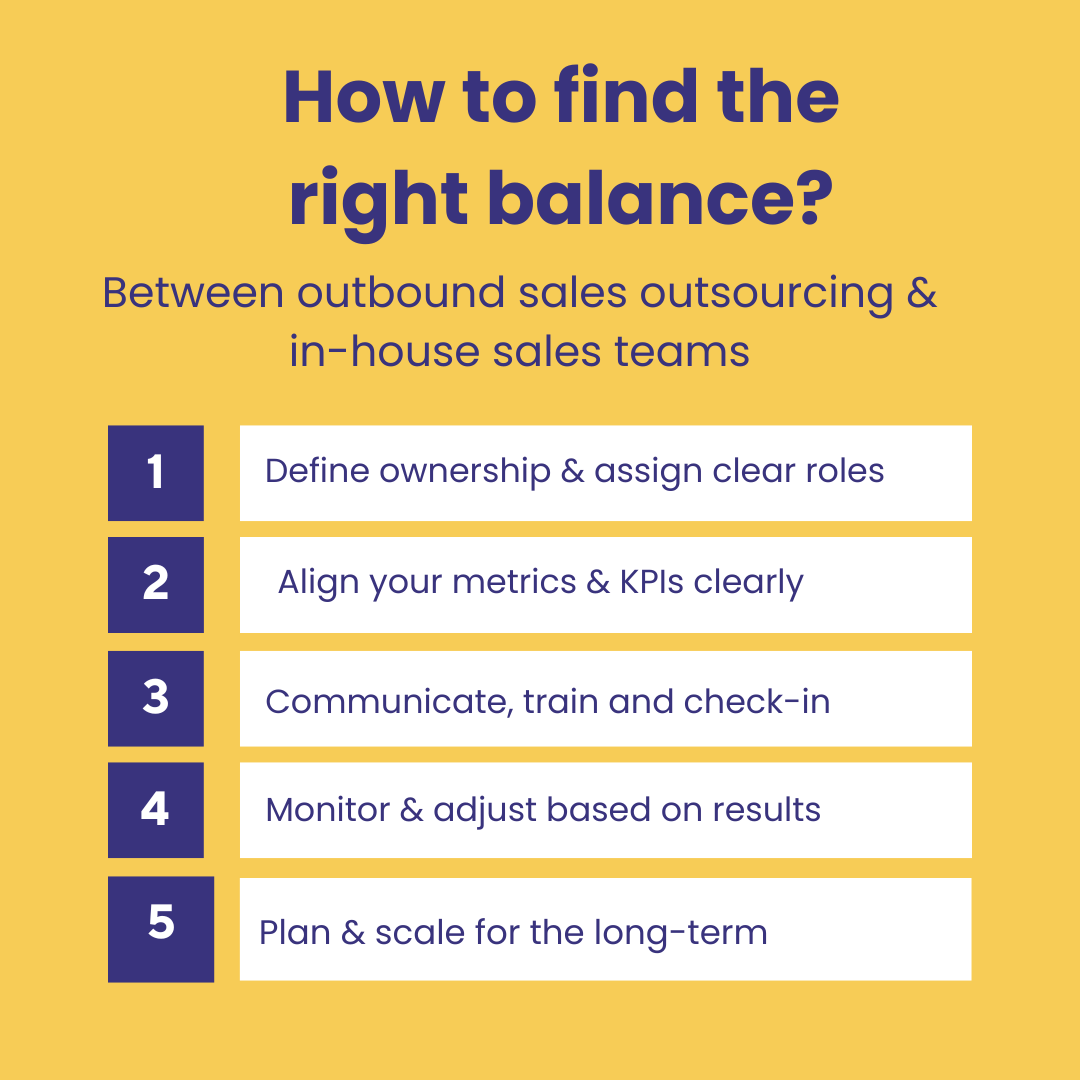
Outsourced Sales Team vs In-House Team: Finding A Balance
The sales outsourcing vs in-house sales team debate doesn’t have to be all or nothing. Many companies use a hybrid approach: outsource lead generation, but keep closing in-house.
Here’s how to make it work:
Step 1: Define ownership: Clearly assign roles (e.g., outsourced team handles leads, in-house closes) and define the responsibilities associated with them.
Step 2: Align metrics: Measure both teams on revenue, not just activity.
Step 3: Communicate & train: Treat outsourced teams like internal staff with regular check-ins.
Step 4: Monitor & adjust: Track performance and shift focus where needed.
Step 5: Plan for the long-term: Start with outsourcing for speed, then bring it in-house when it makes sense.
Scaling Your Outbound Engine with Cleverviral
For VPs of Sales and RevOps leaders, the decision between outbound sales outsourcing vs building an in-house team depends on your business goals. If you need quick results, outsourcing can be a game-changer. Conversely, if long-term brand alignment is your focus, an in-house team may be the better fit.
If you’re curious about which of the two approaches is best for your business, feel free to drop a line on hi@cleverviral.co or book a call now!
Free POC
Reading about outbound isn't running it. Want us to run yours?
Apply below. If we're a fit, we run a real pilot on your ICP and show you the actual replies before you commit to anything.