How to Launch a Podcasting Cold Email Campaign Using AI? – Stepwise Workflow & Best Practices
Want to land more podcast guests and sponsorships? Learn how you can automate your podcasting cold email campaign using AI tools in our lates article.
Cleverviral
·
January 30, 2025
·
14 min
Cold email has transformed dramatically in the last few years. Traditionally, launching a cold email campaign meant spending countless hours researching prospects, manually crafting personalized emails and painstakingly following up with every lead.
Now with AI,the landscape has changed – allowing you to scale your outreach effortlessly – automating personalization, improving response rates & optimizing email sequences with data-driven insights.
One area where cold email is making a huge impact lately is the podcasting industry. Doesn’t matter if you’re a podcaster looking to invite industry-leading guests, or seeking brand sponsorships & collaborations; AI-driven cold outreach can streamline the entire process in just a few clicks.
The result? Better personalization & seamless follow-ups based on the recipient’s engagement.
Our article explores how to leverage AI for a podcasting cold email campaign, alongside discussing the key best practices and common mistakes to avoid. By the end, you’ll have a clear framework to leverage AI to automate cold outreach for podcasting.
So what are you waiting for? Let’s get started.
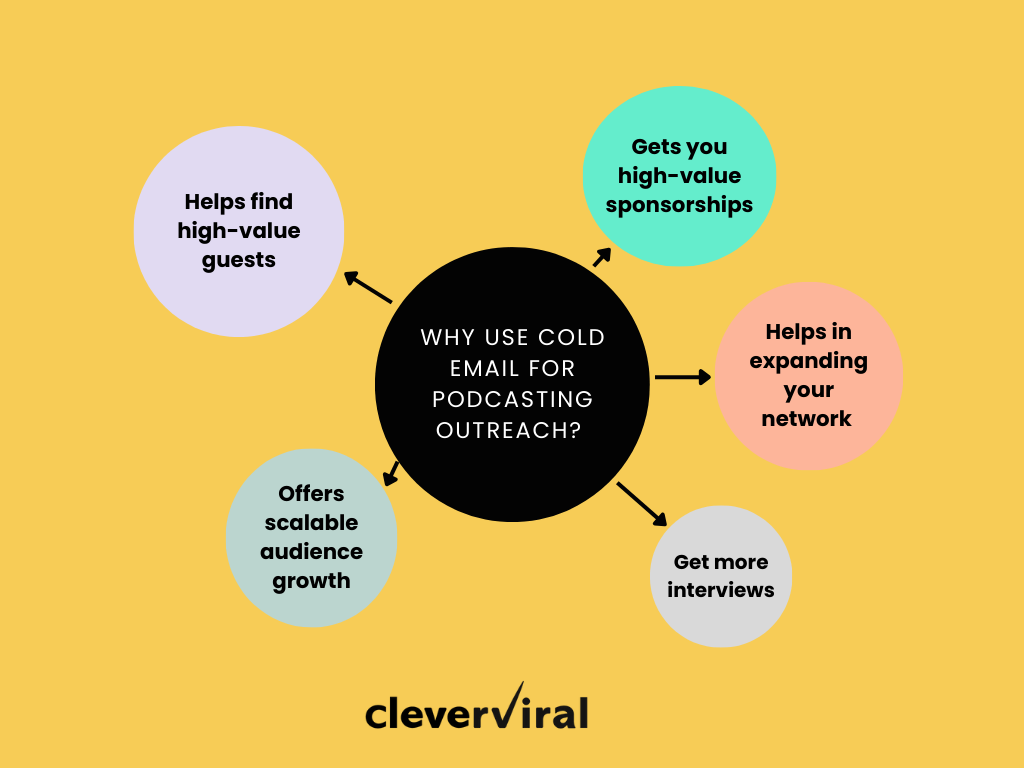
Why Use Cold Email for Podcasting? – Five Key Reasons
Now while cold email’s usually associated with sales & lead generation – it's also an incredibly powerful tool for podcasters looking to grow their brand. A well-structured podcasting cold email campaign allows you to not only connect with high-profile guests, but also secure sponsorships and expand your audience.
Given below is a detailed breakdown of the key reasons why podcasting cold outreach is essential for serious podcasters:
1. Find high-value guests
Finding great podcast guests is one of the most pressing challenges for hosts. High-profile individuals receive 100s of emails per day, making it difficult for you to grab attention.
However, leveraging AI for a podcasting cold email campaign makes this easier by:
Identifying the right guests: AI tools like Clay and PhantomBuster allow you to extract lists of people who follow competitors, engage with industry content, or have been featured on other podcasts.
Personalizing the outreach: Instead of sending a generic invite, AI can analyze the guest’s LinkedIn bio, past interviews, and recent content to generate specific, engaging interview questions that make the email feel custom-made.
Automating follow-ups: Many guests don’t respond to the first email, but AI-driven follow-up sequences ensure that engagement doesn’t drop off.
A cold email that addresses the guest by name, references their expertise, and provides insightful questions significantly increases the chances of getting a positive response.
2. Secure sponsorships
Another benefit of launching a podcasting cold email campaign is the number of sponsorships you can secure – simply by sending potential sponsors an email. Many brands are bombarded with such requests, and a generic pitch rarely gets noticed.
This is where AI helps enhance sponsorship outreach by:
Analyzing competitor sponsorships: AI tools can scan industry podcasts to identify which brands are actively investing in sponsorships.
Personalizing the sponsorship proposal: Instead of sending a generic "Would you like to sponsor my podcast?" email, AI can generate data-driven pitches that highlight a brand’s audience overlap with your listeners.
Automating response tracking: AI-powered tools like Smartlead and HubSpot track sponsor engagement, allowing you to adjust your outreach strategy based on interest levels.
A highly personalized AI-powered cold email that demonstrates a clear value proposition for the sponsor is far more likely to result in a deal.
3. Expand your network
Podcasting isn’t just about creating content—it’s also about building relationships. A strategic podcasting cold outreach campaign can help you connect with industry leaders, fellow podcasters, and potential collaborators. AI makes this easier by:
Identifying the right people to contact: AI scrapes LinkedIn, Twitter, and industry forums to find influencers and thought leaders who match your niche.
Crafting personalized introductions: Instead of sending a vague "Let’s connect" message, AI generates personalized intros that highlight shared interests or industry expertise.
Tracking engagement: AI tools monitor who is opening and engaging with your emails, allowing you to prioritize follow-ups with the most promising leads.
With AI, networking becomes a scalable, systematic process rather than a hit-or-miss effort.
4. Offers a scalable audience growth strategy
Growing a podcast audience organically takes time, and launching a podcasting cold email campaign is one of the fastest growth hacks to reach new listeners by:
Contacting influencers and industry leaders to share episodes with their followers.
Getting featured on other podcasts by pitching yourself as a guest.
Building partnerships with media outlets and content aggregators.
By leveraging AI, you can scale this outreach without sacrificing personalization, ensuring your emails resonate with recipients.
5. Hyper-personalized outreach to secure interviews
The most successful podcasting cold email campaigns focus on hyper-personalization. AI enhances personalization by:
Analyzing the guest’s online presence and generating custom interview questions.
Incorporating relevant data points, such as their recent publications, achievements, or company milestones.
Optimizing email structure to ensure engagement (e.g., adjusting tone and length based on recipient behavior).
This approach ensures that every cold email feels bespoke and engaging, increasing the likelihood of securing top-tier guests.
Automating A Podcasting Cold Email Campaign Using AI – Stepwise Workflow
AI-driven email outreach eliminates guesswork and makes cold email for podcasting a simple, highly-scalable process.
Given below, is a stepwise guide to launching a high-performing podcasting cold email campaign using AI tools like Clay:
Step 1: Build your prospect list
A successful podcasting cold email campaign starts with figuring out the right audience you want to reach out to. Instead of manually scouring through sources for potential guests or sponsors – you can leverage AI to automate and simplify the list building process:
You can use LinkedIn scraping tools like PhantomBuster to extract followers of relevant competitors or influencers in your niche.
You can then filter the prospects based on industry, job title, and engagement using tools like Clay to ensure you’re reaching out to highly relevant contacts.
Once you’ve done this, you can enrich the data with email finders like Prospeo; using them to gather verified contact details.
Step 2: Extract & verify contacts
Once your podcasting cold email campaign’s prospect list is ready, the next crucial step is email extraction and verification. Without this step, you risk sending emails to invalid, outdated, or incorrect addresses – thereby harming your sender reputation and reducing deliverability rates and possible domain blacklisting.
To ensure your cold email for podcasting reaches the intended recipient’s inbox, you need to use AI-powered tools like Prospeo, which can:
Help you find verified emails from the prospect’s LinkedIn profiles
Help filter out invalid addresses to improve deliverability,
And eventually segment the contacts based on email availability, ensuring efficient outreach.
By using AI-powered email verification, you ensure that every email sent lands in the prospect’s primary inbox, thereby increasing the chances of a positive response.
Step 3: Running personalization
The third step in automating your podcasting cold email campaign involves running personalization using AI. After you’ve extracted the prospect’s details, it is then fed into OpenAI via Clay to generate unique, AI-powered interview questions tailored to the guest’s specific field of expertise.
This is what the prompt possibly looks like:
“ {{full_Name}} is my upcoming podcast guest for a show that highlights industry leaders. They are [Job Title] at [Company Name] in the [Industry] industry. Their LinkedIn bio is as follows: [Insert Bio]. Generate three novel and insightful interview questions that position them as an expert in their industry."
This prompt ensures that the AI-generated questions feel specific, relevant, and engaging. You can add conditions to the prompt to make it feel more personalized, while also eliminating the need for manual research.
You can leverage AI outbound agents to automate this process, so as to send 1000s of personalized cold emails at scale.
Step 4: Testing & optimizing the AI questions
While the AI-generated questions are already highly relevant, optimization and A/B testing play a crucial role in refining the approach.
You can test the questions for relevance, engagement and effectiveness, with different variations to ensure only the best kind of questions are sent out in your email campaign.
Additionally, you can also add more examples inside Clay to refine the output and improve your podcasting outreach strategy.
Step 5: Setting up the email campaign
Once you’ve generated the AI questions, you can move to setting up your email campaign. You can set up an email sequence with the first email and then add subsequent follow-ups.
Here’s a brief overview of how you can structure your podcasting cold email campaign sequence:
Email 1: Add a personalized hook and introduction with a low-friction CTA
Email 2: Could contain a reminder alongside a little reinforcement of value (why should they say ‘yes’?)
Email 3: The final email could contain a slight nudge, alongside creating urgency to close the loop on the conversation.
You can further experiment with a few different approaches, and optimize your sequence based on the campaign results.
Step 6: Track and optimize for scalability
The last step in automating your podcasting cold email campaign is to track the campaign performance and optimize it based on the insights gathered. You can experiment with different types of personalization alongside A/B testing subject lines and follow-up approaches.
Finally, you can find your winner emails and reuse them in future campaigns, or find out new ways to communicate your offer.
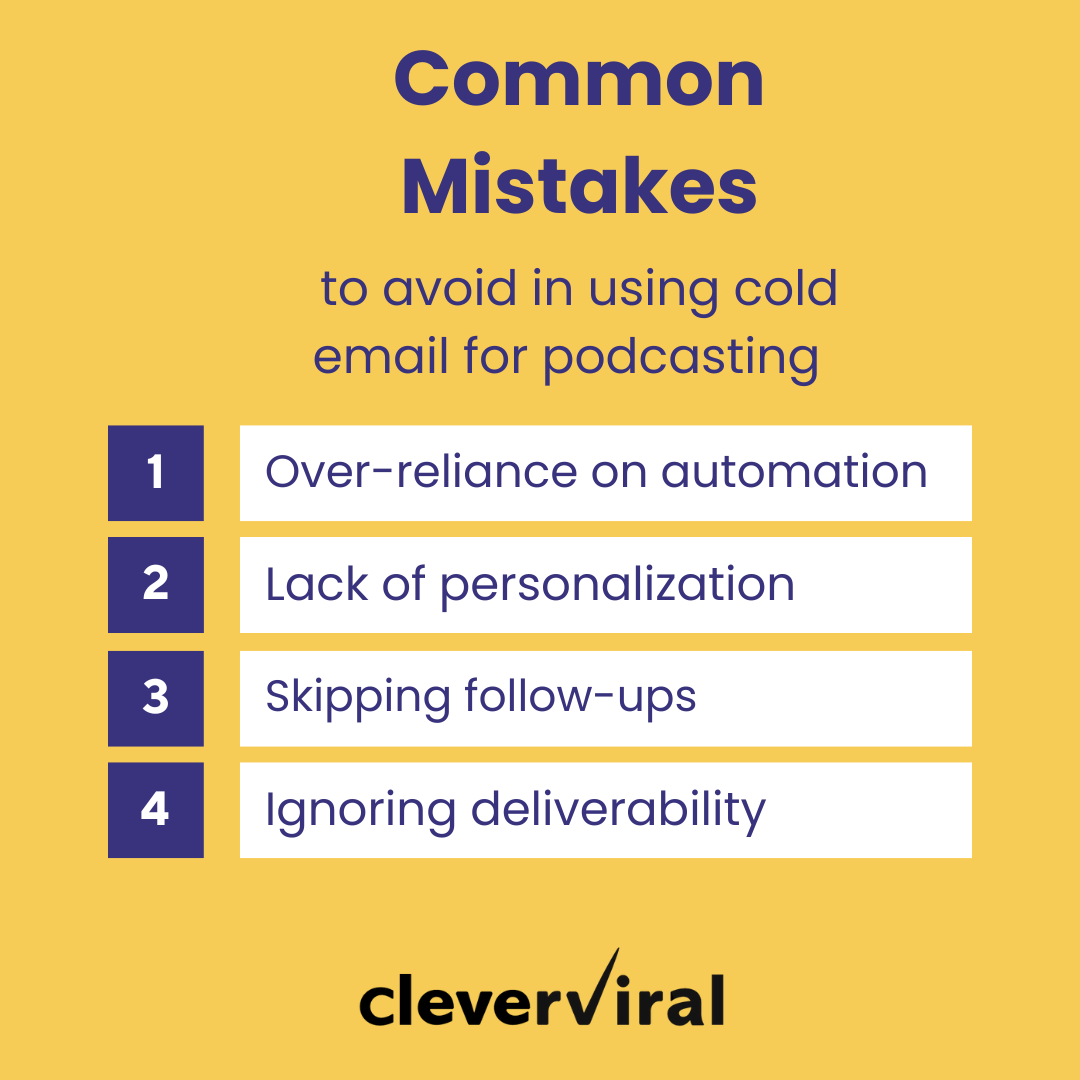
Common Mistakes to Avoid in Podcasting Cold Email Outreach
Even with the best tools around, a podcasting cold email campaign can fail if you’re not keeping tabs on what’s happening.
Given below, is a list of some common mistakes to avoid so as to keep your cold outreach for podcasting both effective and engaging:
1. Using too much automation
AI is an incredible tool for scaling your podcasting cold email campaigns, but over-reliance on automation can make your outreach feel generic and impersonal.
Many podcasters make the mistake of using fully automated AI-generated emails without reviewing them, leading to cold emails that sound robotic and lack authenticity.
Make sure to manually review the AI-generated emails, and add a personal note in each email, if possible.
Remember to use AI as an assistant, not a replacement for the personal human touch – to keep things warm and engaging.
2. Lack of personalization
One of the biggest mistakes in cold email for podcasting is sending generic, template-based outreach. Podcast guests—especially high-profile ones—can immediately tell when an email is mass-produced. If your email doesn’t feel like it was crafted specifically for them, they won’t respond.
Make sure to customize at least one part of your email or leverage AI to pull guest-specific or account-specific information.
3. Skipping follow-ups
Many podcasters assume that if a guest doesn’t respond to the first email, they’re not interested—but that’s not true, with over 60% responses to cold emails coming from follow-ups. This is why a structured follow-up sequence is essential for successful podcasting cold email campaigns.
The first follow-up should be 3-4 days after the first email, with the final nudge coming about a week later.
Moreover, instead of simply saying: “Just following up”, add a new incentive or valuable resource for the recipient.
4. Ignoring deliverability
A great podcasting cold email campaign is useless if it never reaches the recipient’s inbox. Many podcasters ignore email deliverability factors, causing their emails to end up in spam folders or bounce entirely.
Make sure you’ve warmed up your domains, apart from verifying the prospects’ emails. In addition, you must also look to optimize your email by avoiding spam triggers and using AI spam filters to reduce the risk of being marked as “spam”.
By avoiding these mistakes, you’ll increase response rates, secure more high-value podcast guests, and create a strong reputation for your outreach efforts.
Scale Your Podcasting Cold Email Campaign with Cleverviral's AI-Powered Outbound Systems!
AI has revolutionized cold email for podcasting, making it easier to book guests, secure sponsors, and grow your audience. However, the right strategy and execution are key.
If you want to scale your podcasting cold outreach campaigns, Cleverviral can help with AI-powered outbound systems that maximize guest bookings and sponsorship deals for your podcast.
We also helped an AI media company get 111 opportunities, selling sponsorships and podcast collaborations on their behalf. You can read about it here.
If you’re a media company looking for similar results, reach out to us on hi@cleverviral.co or simply fill out the form on our website.
Until then, happy prospecting!!
Free test campaign
Reading about outbound isn't running it. Want us to run yours?
Apply below. If we're a fit, we run a real pilot on your ICP and show you the actual replies before you commit to anything.