How to Leverage Cold Email for Ecommerce Agencies? - Best Practices and AI Workflow
Learn how to leverage cold email for ecommerce agencies, alongside the stepwise process of automating this outbound workflow using AI tools like Clay.
Cleverviral
·
December 10, 2024
·
12 min
In today’s hyper-competitive eCommerce landscape, acquiring high-value clients has become a challenge. The global eCommerce market, projected to reach $5 trillion by 2024, and continuing to expand rapidly, but so does the competition among service providers vying for a slice of the pie. According to McKinsey, around 360 billion emails are sent & received everyday, making it difficult for service providers to stand out with generic outreach efforts.
But scaling personalization without sacrificing quality can be challenging. This is where AI-driven cold email strategies become a game-changer. By automating repetitive tasks and intelligently segmenting audiences, companies have seen a boost in productivity and significantly improved lead qualification.
AI tools allow eCommerce service providers to maintain a personalized approach at scale, ensuring each prospect receives tailored, relevant messaging that resonates.
In this article, we’ll dive into how cold email can transform eCommerce client acquisition and explore how AI-powered platforms like Clay can help you automate, optimize, and scale your outreach—without losing the personal touch that drives results.
So let's dive right in!
How to Utilize Cold Email for eCommerce Services? - A Stepwise Process
Using cold email for eCommerce isn't just about sending mass messages—it’s a strategic approach to connect with eCommerce businesses in need of your services. When done right, it helps service providers build trust, nurture leads, and generate consistent growth.
Here’s a quick overview of how you can effectively utilize cold email for eCommerce services, ramping up your sales pipeline with highly-relevant, hot leads:
1. Identifying key decision-makers
Finding key contacts like founders, marketing heads, or product managers is crucial when launching cold email for eCommerce service providers. These decision-makers hold the purchasing power and are more likely to be engaged with your pitch. One effective way to pinpoint these contacts is by leveraging LinkedIn. With LinkedIn’s powerful search filters, you can easily narrow down prospects by job title, company size, industry, and location, allowing you to target those with real decision-making authority.
In addition to LinkedIn, using tools likeHunter.io can further streamline your prospecting process. Using tools like Hunter and their integrations allow you to find verified email addresses for the decision-makers at companies you're targeting, increasing the possibility of a positive response.
2. Sourcing and Building Lead Lists
The foundation of any effective campaign using cold email for eCommerce is a well-researched and targeted lead list. Start by identifying your ideal client profile (ICP), including business size, niche (e.g., fashion, beauty, or electronics), and key decision-makers such as founders or eCommerce managers.
Tools like LinkedIn Sales Navigator, Clay, Apollo.ioand Store Leads can be quality sources of eCommerce leads – helping you filter prospects based on factors like industry, platform (e.g., Shopify, BigCommerce and WooCommerce), or location.
Once the leads have been sorted, ensure that they’re accurate by validating the emails through NeverBounce. A clean & verified list will ensure that you’re reaching out to the right person – and thereby increase your chances of a positive response.
3. Segmenting your lists
Once you’ve created your lead lists, it's important to segment the lists, so as to ensure the success of cold email for your eCommerce agency. You can divide the data into different segments based on common pointers that bind a specific cohort of prospects together – allowing you to tailor the message as per their common behaviors, revenue ranges or industries among others.
Here’s how to leverage segmentation while doing cold email for eCommerce agencies:
Identify Key Segmentation Criteria:
The first step starts with identifying the key criteria based on which you want to divide the data. These can be as follows:
Company Size: Larger enterprises may require more complex, enterprise-level solutions, while smaller startups might be more interested in cost-effective options or scalability.
Revenue/Financials: This helps you assess whether a company can afford your services and what kind of solutions they may be looking for.
Industry: Tailoring your messaging based on industry-specific needs, whether it's fashion, tech, beauty, or health, ensures you’re speaking their language.
Growth Stage: Segmenting by startup, scaling, or established status helps align your message with where the business is in its lifecycle. Startups may be looking for foundational strategies, while established companies might need advanced solutions to scale further.
Use Tools for Data Collection
Platforms like Apollo.io, Clay, and LinkedIn Sales Navigator allow you to gather and organize this data in a structured way. These tools can help you filter leads by the specific criteria mentioned above, making it easy to build segmented lists based on factors such as company size, revenue, or industry.
Apollo.io provides detailed filters like company size, industry, revenue, and employee roles, allowing you to easily build segmented lead lists.
Clay integrates various data points from public profiles, making it easier to categorize leads based on revenue, company size, or industry focus.
LinkedIn Sales Navigator offers advanced search filters, including growth stage, company size, and industry, allowing you to create highly segmented prospect lists.
Segment Your Leads Based on Growth Stage:
This is a powerful way to tailor your cold email outreach. Here’s a breakdown of possible segments:
Startup eCommerce Brands: These businesses often need help with building their online presence, establishing marketing strategies, and growing brand awareness. They’re looking for affordable, scalable solutions.
Scaling Businesses: These companies are in a growth phase and might need advanced marketing strategies, customer retention solutions, or tools to optimize operations. You can offer solutions to scale their business efficiently and sustainably.
Established Enterprises: Large, established companies often look for innovative, cutting-edge solutions to remain competitive. They may need enterprise-level integrations, custom solutions, or high-level strategy.
Once you’ve segmented the list based on the growth stage of the company, you can easily start sending out cold emails to get eCommerce clients. Now while this process is really valuable, it might also take a lot of your time (when done manually).
This is where automating this process can help. In the next section, we’ll take a look at how you can use AI tools to automate your list segmentation.
Use AI to Automate Segmentation
You can automate segmenting your lists with the plethora of AI-powered tools in the market. These tools will not only help you segment by analyzing large datasets & grouping leads based on shared characteristics, but also identify patterns that might be difficult for people to spot otherwise.
You can use Clay to automatically classify the leads into relevant segments, or tap into the likes of Hunter and Apollo to gather, segment and update prospect information in real-time – ensuring accurate segmentation.
One can also score the leads by their potential to respond, allowing you to target only the highest value prospects in your cold email campaigns.
4. Structure the email well
A well-structured cold email is essential for capturing attention and driving engagement – effectively serving as the first touchpoint in your outreach. When used properly, it can also set the tone for the rest of your relationship with the prospect.
Each element of the email plays a crucial role in building a connection and piquing the recipient's interest. Here’s how you can structure your emails to maximize the chance of a positive response:
Subject Line: The subject line is your first chance to grab attention. It should spark curiosity, but also be directly relevant to the prospect’s needs. A good subject line shouldn’t feel like a sales pitch but rather a value proposition.
For instance, “Scaling eCommerce sales” gives a clear benefit without being overly salesy. The goal is to generate enough interest to prompt the recipient to open the email.
Personalized first line: Personalization is one of the most effective ways to connect with prospects, especially when running cold email for eCommerce services.
Starting with a tailored first line that mentions something specific about the prospect’s business (such as a recent achievement, a challenge they’re facing, or something unique about their product or service) or their own professional accomplishments – it shows that you’ve done your research and aren’t sending out a generic message.
This simple step can significantly improve engagement and show that you're focused on their needs, not just your own agenda.
Email Body: Once the prospect is intrigued enough to open your email, the body needs to deliver. It should quickly get to the point, offering a solution to a problem or pain point that is likely affecting the prospect. Focus on how your services can specifically address their challenges and help them achieve their goals.
Keep the email concise and to the point. Avoid unnecessary fluff or overly long paragraphs, as decision-makers often skim emails in a busy workday. One or two clear points of value will suffice.
Social Proof: Adding case studies, testimonials, or any form of social proof that validates your expertise can significantly increase trust. Sharing how you’ve helped similar businesses, particularly in the eCommerce space, shows that you understand the industry and can deliver results.
Whether it's a success story, a relevant testimonial, or even recognizable brands you’ve worked with, social proof helps to build credibility and reassure the prospect that you can help them achieve similar success.
CTA (Call-to-Action): A clear and easy-to-follow call-to-action is crucial in guiding the recipient on what to do next. However, the key here is to avoid pushy language.
Instead of saying something aggressive like “Buy now” or “Sign up immediately,” opt for a more conversational tone. A good CTA could be something like, “Up for a 15-minute call to discuss solutions for your eCommerce business growth?”.
Having a clear CTA that outlines the most likely outcome you’re looking to elicit from the prospect makes it easy for them to act upon without feeling pressured.
5. Follow-up strategically
Most responses to cold emails come after follow-ups, making persistence a key element in any cold email campaign. Many prospects may not reply to the first email due to timing, competing priorities, or simply overlooking your message. This is where follow-up emails become crucial.
It’s important to remain professional and polite while gently nudging them for a response. Tools like Woodpecker further help automate follow-up sequences, ensuring that you stay top-of-mind without becoming intrusive.
Automating Cold Email for Ecommerce Agencies with AI – Full Clay Workflow
As an ecommerce agency owner (or marketer), leveraging automation and AI is critical to the success of your cold outreach campaign. While you can manually write emails for each individual, it takes a lot of research and writing work - both of which could be utilized better elsewhere.
That's where Clay comes into the picture - helping you not only personalize messaging at scale, but also find relevant insights about the prospects. Given below, is an in-depth overview of how to automate cold email for eCommerce agencies using Clay.
So let's dive right in:
1. Building a Lead List of eCommerce Brands
Start by creating a list of potential eCommerce clients. To do this, you can either leverage Apollo, or opt for a directory like Store Leads or MyLeadFox. Both of these platforms have tons of useful eCommerce data, which you can leverage to send a cold email for eCommerce agencies.
At the search and segregation level, you can opt for platform-specific, revenue-specific or even location-specific filters. In this case, we can leverage the Shopify Plus filter, since it involves brands with higher order volume and revenue.
Pro Tip: When building your lead list, ensure that you verify each brand's status as a legitimate eCommerce business. Not every company using Shopify Plus will fit your criteria. Here’s how you can refine the list:
Use Google Shopping Integration: Clay allows you to pull in Google Shopping data to check if a brand has active listings. This ensures that the company is genuinely engaged in eCommerce.
Filter by Domain: Cross-reference the data to ensure that the Google Shopping link matches the company’s domain. For example: If a company shows up in Google Shopping but doesn’t match the original domain, it’s likely not a relevant lead.
Filtering this data helps keep your list clean and increases the odds of a positive response.
2. Finding and Calculating Average Order Value (AOV)
Once you have your list, the next step to automate cold email for eCommerce involves finding each brand’s average order value (AOV). This is where Clay’s automation features shine. While tools like Claygent might not always pull the desired results, you can use alternative methods such as:
Google Shopping Price Data: Extract product prices and average them out.
SERPer.dev: A cost-effective scraper that pulls product data more accurately.
Additionally, here’s how to automate the calculation:
Step 1: Pull in product prices from Google Shopping.
Step 2: Create a formula to calculate AOV based on typical purchase quantities. For example, if most buyers purchase three units, multiply the average product price by three.
Example Output: “A typical order on your site seems to be around $150, assuming a purchase of three items like [Product A], [Product B], and [Product C].”
3. Extracting Web Traffic Data
Once you've calculated the AOV of the store, the next step to automate cold email for ecommerce agencies involves extracting the web traffic data. You can personalize the email with insight - using Clay to automate the process and pull data from the likes of SimilarWeb or SEMRush.
Key Steps:
Create a formula to normalize URLs and fetch traffic data.
Once done, you can leverage ZenRows to scrape programmatic pages for traffic insights. Ensure that JavaScript rendering is enabled for accuracy. Alternatively, you can also use Crunchbase which offers SEMRush data that can be accessed more cost-effectively.
4, Generating Personalized Cold Emails
Now that you have both the AOV and traffic data, it’s time to craft a personalized cold email for eCommerce agencies to highlight the insight and pitch their offer. That's where automating this process with Clay helps.
You can run the prompt as outlined in the video, generating the email copy at scale for thousands of prospects.
5. Automating the Entire Workflow in Clay
Once your email templates and data inputs are ready, automate the entire process by setting up workflows in Clay:
Data Enrichment: Continuously pull updated traffic and product data.
Email Sequencing: Use Clay to push personalized emails into your CRM or email marketing platform.
Lookups for Contacts: Avoid redundancy by checking for existing contact data before running new enrichments.
You can follow the steps outlined further in the video above, using it to craft the emails at scale. In the next few sections, we'll analyze some common mistakes you need to avoid, while also looking at how automating cold email for eCommerce agencies can be a game-changer.
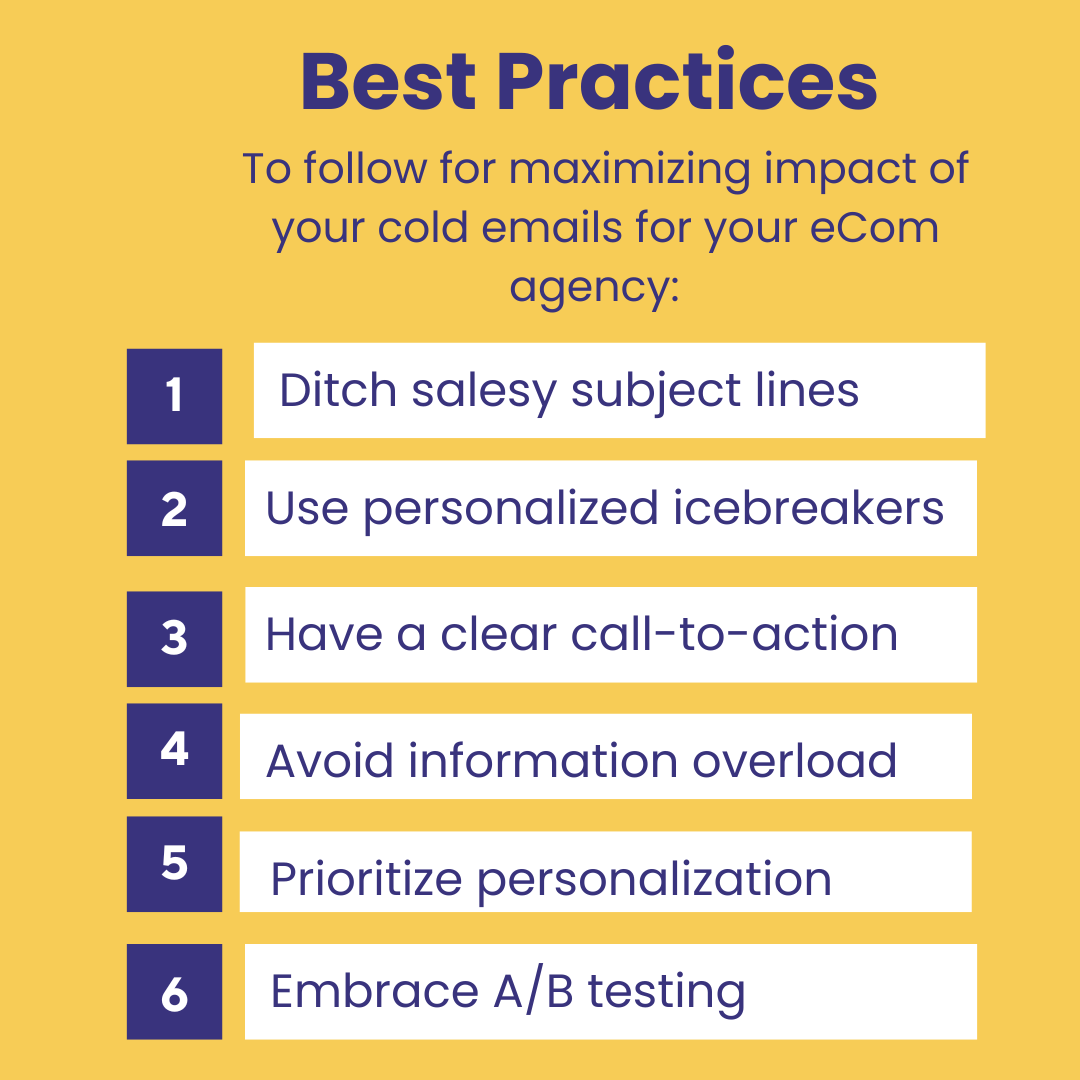
Best Practices to Follow When Using Cold Email for eCommerce Agencies: Key Aspects
Even with a solid strategy, it’s easy to fall into traps that derail your efforts to scale cold email for eCommerce. Mistakes such as cramming too much information into a cold email or neglecting personalization can drastically lower response rates.
Given that, its crucial to keep in mind a few things before you launch your cold emails for the agency's services. Here's what they are:
1. Ditch salesy subject lines
Think about it: how often do you open emails with subject lines like “Limited-time offer!”or “Don’t miss this deal!” Probably not often. That’s because salesy subject lines in your cold email for eCommerce screams “spam” and get ignored. Instead, your subject line should spark curiosity or offer value—without sounding pushy.
A good rule of thumb? Keep it subtle and relevant. For example:
“Quick idea for boosting [brand’s name]’s conversions”
“Thought you might find this helpful, [first name]”
Why this works: It feels natural, almost like a helpful suggestion rather than a hard sell. When your subject line hints at value rather than a pitch, it’s more likely to stand out in a crowded inbox and drive opens.
2. Use personalized icebreakers
The first line of your cold email for eCommerce is critical. If it’s generic, your chances of getting a response plummet. Think about it—if someone started a conversation with “Dear valued client,” would you feel compelled to respond? Probably not.
Personalized icebreakers show you’ve done your homework and care about the recipient’s business.
Instead of starting with “I hope this email finds you well,” try something like:
“Noticed your recent product launch—impressive work! Have you considered scaling with [specific solution]?”
“Saw [brand] featured in [publication]! Congrats on the recognition. I have some ideas that could help you build on that momentum.”
Why this works: Personal touches immediately capture attention. It shows the recipient that you’re reaching out for a reason, not just sending a blanket email.
This small effort can make a huge difference in whether your email gets a response.
3. Always include a clear call-to-action (CTA)
You’ve written a great email, personalized it, and grabbed the reader’s attention. Now what? If your cold email for eCommerce doesn’t end with a clear CTA, the prospect might be interested but unsure of what to do next. And that’s a missed opportunity.
Your CTA should be simple and actionable, guiding the prospect toward the next step. For example:
“Does a quick 15-minute chat next week work to explore this further?”
“Would you like me to send over a quick demo for you to review?”
Why this works: A clear CTA removes ambiguity. It makes it easy for the recipient to know exactly what you’re asking and increases the chances they’ll follow through.
4. Don’t overload prospects with information
It’s tempting to include everything about your services in one email—but resist the urge. Information overload overwhelms prospects and dilutes your message. Instead, focus on one or two key points that are most relevant to the recipient.
For example, if you’re reaching out to an eCommerce brand struggling with abandoned carts, highlight how your solution can reduce cart abandonment rates rather than listing all your services. You can always provide more details in follow-ups.
Why this works: Keeping your message concise ensures that your main points are clear and impactful. It also leaves room for curiosity, encouraging prospects to engage further to learn more.
5. Prioritize personalization at scale
Let’s face it—nobody likes receiving emails that feel mass-sent. Personalisation is the secret sauce that makes cold emails work, but doing it at scale can feel daunting. This is where AI tools come into play. Platforms like Clay can help automate the personalisation process by pulling in dynamic fields like names, company details, and even recent news about the recipient.
Instead of sending a generic email, you can craft something like:
“I noticed [brand] recently expanded into [new market]. Curious if you’re looking for ways to drive more traffic in that region.”
Why this works: Personalisation makes the recipient feel seen and valued. When emails address specific pain points or goals, they’re much more likely to resonate and lead to meaningful conversations.
6. Embrace A/B testing
Even the best-crafted cold email for eCommerce can benefit from tweaks. A/B testing allows you to experiment with different elements of your email—subject lines, body copy, CTAs, and even send times. By measuring what works and what doesn’t, you can refine your approach and improve your results over time.
For example, test whether a question-based subject line like “Struggling with [pain point]?” performs better than a benefit-driven one like “Boost [specific result] with this strategy.”
Why this works: A/B testing provides valuable data that can help you optimize your cold email strategy. Over time, these small improvements can add up to significant gains in open rates, responses, and conversions.
Key Metrics to Scale Cold Email for eCommerce Agencies
Scaling cold email for eCommerce requires more than just hitting "send" on a list of prospects. Success lies in tracking key performance metrics that provide actionable insights, allowing you to fine-tune your strategy and generate high-quality eCommerce leads. Here’s a detailed guide to three crucial metrics you should monitor:
1. Reply rates
Your reply rate shows how many people actually respond to your cold email, offering a clear snapshot of engagement. It’s not just about getting replies—it’s about sparking meaningful conversations that can lead to opportunities.
A high reply rate means your emails are relevant and hitting the mark. If you’re sending cold emails for eCommerce and not seeing responses, it’s likely due to messaging that doesn’t resonate or lacks personalization.
How to improve?
Hyper-Personalization: Craft first lines that feel tailor-made. Mention something specific about their business, like recent product launches or growth milestones.
Clear CTAs: End with an action-oriented question like, “Does this sound like something that would help your team?” Simple and direct encourages responses.
A/B Testing: Test different subject lines, email bodies, and CTAs to find out what grabs attention.
Pro Tip: Think of your email as the start of a conversation, not a pitch. Build rapport first, and the sales conversation will naturally follow.
2. Number of positive responses
Positive replies are gold—they indicate genuine interest, whether it’s a request for more info or an invite to chat. Tracking these helps you understand which leads are warm and worth pursuing.
Positive replies are often considered the start of your sales pipeline. For an eCommerce agency looking to find clients, every positive response is a step closer to a deal. Without them, your efforts won’t translate into actual opportunities.
How to Improve:
Targeted Value Propositions: Speak to specific pain points. Instead of a generic “We help businesses grow,” try “We help eCommerce brands increase repeat purchases with targeted email campaigns.”
Social Proof: Include brief testimonials or case studies. Showing real results builds credibility and trust.
Follow-Up Strategy: Don’t just send one email and wait. Most positive replies come from follow-ups. Use tools to automate these, but keep them personal. A quick, casual “Just wanted to circle back on my last email—curious to hear your thoughts!” can do wonders.
3. Conversions
Conversions are the ultimate goal—turning leads into paying clients. This metric tells you how well your entire process, from outreach to follow-up, is working.
For an eCommerce agency, high conversion rates mean your cold email strategy is driving real results. More conversions = more revenue.
If you’re not converting, something needs tweaking, whether it’s targeting or the way you nurture leads.
How to Improve?
Qualification: Start with a well-vetted list that matches your Ideal Customer Profile (ICP). Reaching out to the wrong people wastes time and effort.
Sales Process Alignment: Be ready to act fast. Once you get a positive reply, qualify the lead and guide them through your sales funnel. Speed matters.
Clear Next Steps: Don’t leave prospects hanging. Suggest the next logical action, like booking a demo or scheduling a call. Use lines like, “Let’s book a quick 15-minute chat to explore how we can help you hit your sales targets.”
Why Automating Cold Email for eCommerce Can Be Game-Changing?
Using cold email for eCommerce works best when it’s personalized, relevant, and timely. For eCommerce service providers, finding and scoring potential leads based on their website traffic, average order value (AOV), and other metrics can give your outreach a cutting edge.
Automating these with AI can help you maximize your outreach potential, helping you hit more prospects with your message, at scale.
Through AI tools like Clay, ZenRows and others, you can:
1. Score potential leads
Scoring leads by AOV and web traffic helps prioritize high-quality prospects for your cold email for eCommerce campaigns. AOV reveals the purchasing power of leads, while web traffic indicates active engagement. By focusing on these metrics, you can target prospects who are more likely to convert, ultimately making it easier to get eCommerce clients and generate more eCommerce leads for your eCommerce agency.
2. Craft personalized messages
Tailoring your cold emails based on each prospect’s data—such as browsing behavior or past purchases—makes your outreach more relevant and engaging. A personalized message speaks directly to the recipient’s needs, increasing the likelihood of a positive response.
This approach is key to finding eCommerce clients for marketing agency and ensuring your cold email for eCommerce campaigns resonate with prospects.
3. Automate lead sourcing and data enrichment
Automating lead sourcing and data enrichment saves time and ensures your prospect lists are always up-to-date. Tools like Clay or Apollo.io can gather essential details automatically, allowing you to focus on crafting targeted emails.
This enables you to run larger cold email campaigns and find more qualified eCommerce leads without the manual effort.
4. Run scalable campaigns without sacrificing personalization
With automation tools, you can scale your cold email for eCommerce campaigns while maintaining personalization. AI-driven tools can generate customized first lines, ensuring every email feels unique.
By segmenting your prospects based on key data, you can send targeted, relevant emails at scale, helping you get eCommerce clients and improve conversion rates without compromising quality.
Supercharge Cold Outreach for Your eCommerce Agency with Cleverviral!
Automating cold email for eCommerce is not just about saving time; it’s about scaling efficiently and consistently generating high-quality leads. AI-powered tools streamline outreach, personalization, and follow-ups, giving you a competitive edge.
If you're a business that's just started exploring outbound (or one that's looking to scale things up), it makes sense to work with a lead generation expert like Cleverviral. We not only help you scale your cold outreach campaigns, but also maximize the value of AI when it comes to cold emails.
To get started, simply reach out to us on hi@cleverviral.co or fill out the form on our website.
Until then, happy prospecting!
Free POC
Reading about outbound isn't running it. Want us to run yours?
Apply below. If we're a fit, we run a real pilot on your ICP and show you the actual replies before you commit to anything.