
Prospecting
What’s the Ideal Cold Email Length? – Best Practices & In-depth Analysis
Maintaining the ideal cold email length is important for the success of your outreach. Learn how to optimize the length of a sales email in our in-depth article.
Maintaining the ideal cold email length is important for the success of your outreach. Learn how to optimize the length of a sales email in our in-depth article.
When it comes to B2B client acquisition, cold email is often the first channel you’ll resort to when looking to connect with potential clients and partners. Yet, despite its significance, the debate over the ‘ideal cold email length’ looms large, with a variety of opinions from different practitioners.
Traditional advice has often leaned towards brevity, advocating for succinct messages that get straight to the point. However, a new wave of thought encourages longer emails, structured to capture the reader’s attention in an F-shape pattern, promising better engagement and response rates.
This divergence in strategies underscores the complexity associated with cold emails, especially for companies that are just starting out with using this acquisition channel.
Given the above factors, our article will not only seek to answer the question of “How long should a cold email be?”, but also the best practices associated with figuring the right cold email length.
So let’s dive right in.
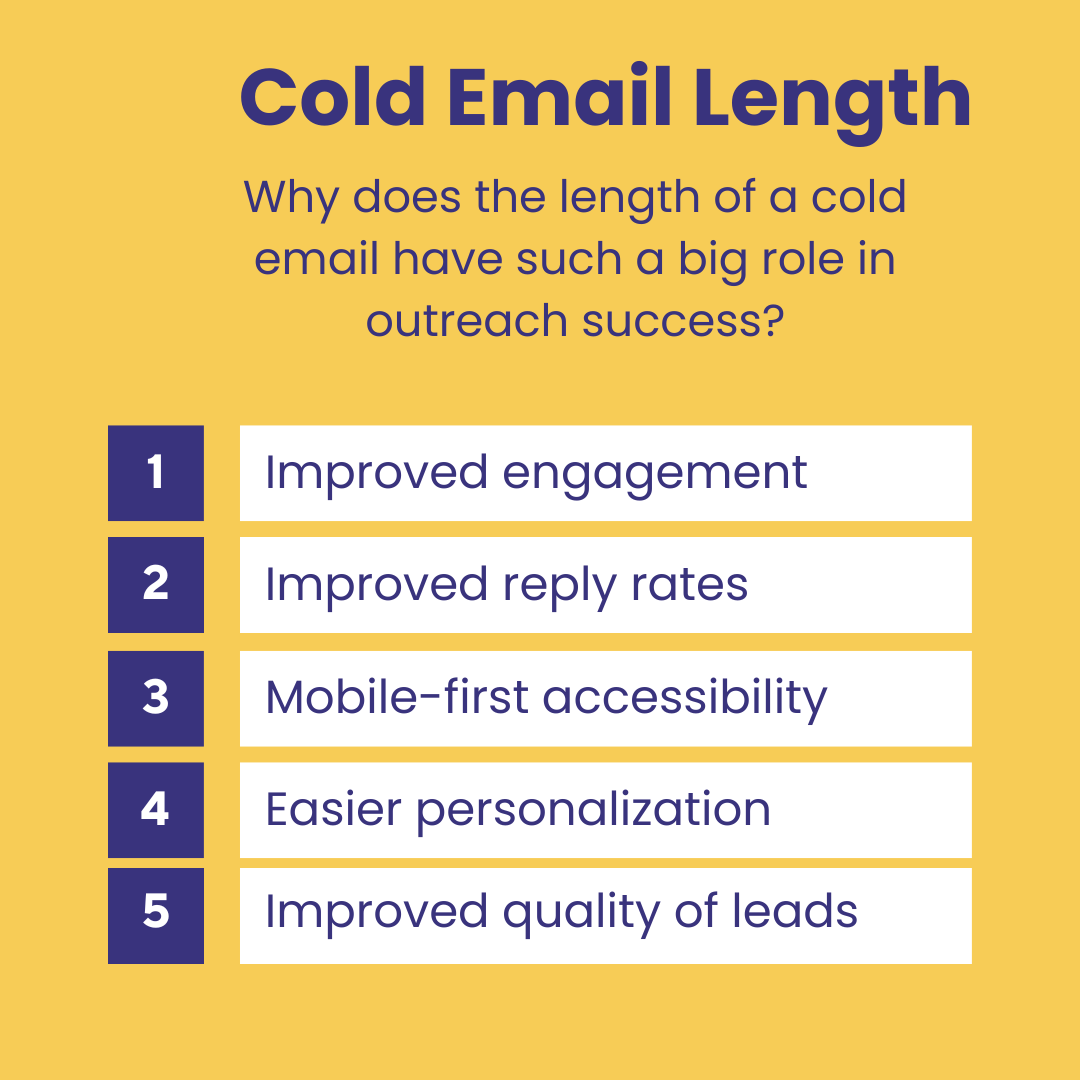
Understanding why cold email length matters is significant for a variety of reasons, some of which are as follows:
This level of brevity can significantly improve the recipient’s engagement with the content. A cluttered or overly lengthy message can deter readers before they fully engage with the content.
Now that we've got an understanding of the importance of maintaining the ideal cold email length, the next step is to learn more about the number of cold emails you should be sending.
Before zeroing in on the ideal length of a sales email, it's pivotal to address the quantity aspect of your outreach strategy. The number of emails you decide to send in a sequence usually depends on the nature of your relationship with the prospect. If you’ve already built a rapport, you’d have to send fewer emails.
Alternatively, if you’re reaching out cold to the prospect for the first time, you’ll have to send more emails. As per our experiments, a sequence of 3 emails is optimal. This approach balances persistence & respecting the prospect’s time – with the hypothesis that if a prospect is interested, they’re more likely to engage within the first few emails itself.
Sending more than 3 emails without eliciting a response may lead to diminishing returns, potentially alienating the prospect.
With a reply rate of just about 8.5% for every 100 emails, it’s important to maintain a cold email length that not only gets you higher open rates, but also ensures that your messages are read and replied to, promptly.
That being said, a recent study by Boomerang found that emails ranging in the 50-120 word length usually have a higher number of responses. We've tested this hypothesis for our own campaigns, and usually emails up to 120 words work the best, giving us upwards of 15% in reply rates.
Given the above insights, it’s clear that this is the ideal number of words needed to write a persuasive cold email. All you have to focus on is ensuring that the message gets communicated properly.
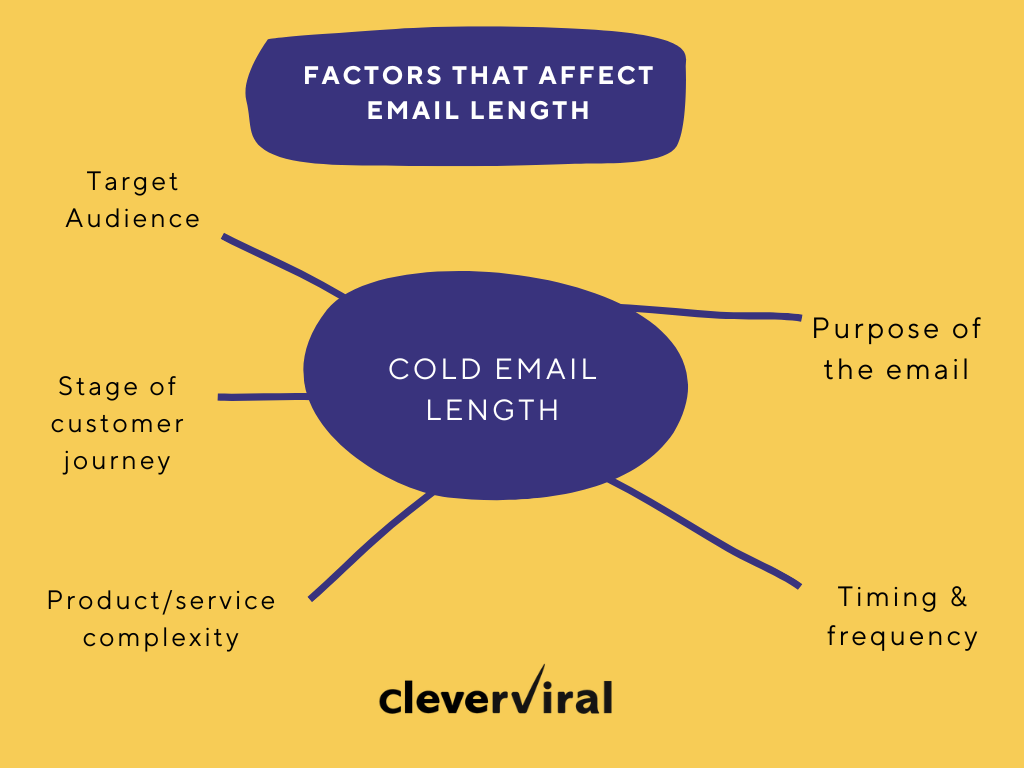
The average email length that yields optimal results isn't a one-size-fits-all metric. Several factors influence the ideal size of your cold email:
Some of them are as follows:
Here, you should optimize for an email length that provides sufficient detail to educate and intrigue, while still being concise enough to not overwhelm, is key.
Conversely, for a recipient who is further down the funnel and already has some familiarity with your product or service, a shorter, more direct email that prompts action (e.g., scheduling a demo or a meeting) could be more appropriate.
Tailoring the cold email length to match the recipient's journey stage ensures your message is relevant and timely, enhancing its impact.
However, complex solutions, especially in areas like B2B tech, healthcare or finance may require a longer email to adequately convey the value proposition and address potential questions or objections.
On the other hand, emails aiming to persuade or call to action might be shorter, focusing on creating a sense of urgency or highlighting a single, compelling value proposition.
At a time when attention spans are dwindling, having a shorter cold email length can be an effective choice. Talking about shorter emails, they can be effective in the following scenarios:
The focus here should be on clarity & relevance, with short, personalized messaging that speaks directly to the customer.
The key here is to reference previous interactions succinctly, reinforcing the value proposition or next steps in a manner that's easy for the recipient to quickly understand and act upon.
While brevity is recommended when optimizing cold email length, overly concise emails also risk under-communicating the message, potentially reducing their effectiveness. When writing cold emails, it’s important to balance conciseness & providing enough insight that captures the prospect’s attention.
A cold email with insufficient information may also seem spammy or lacking in value – thereby diminishing the odds of a positive response. The idea is to craft personalized cold emails that incorporate effective subject lines & email content, thereby maximizing engagement & achieving desired results.
There are circumstances where a longer cold email is not just beneficial but necessary. When introducing your business to prospects unfamiliar with your offerings, a detailed email can provide the necessary context and information to foster interest and trust.
This approach is particularly relevant when your call to action requires a deeper level of engagement or commitment from the prospect. In these cases, a longer email serves to build a foundation of understanding and credibility, essential for advancing the sales conversation.
Achieving the ideal cold email length involves more than counting words; it's about crafting messages that resonate and compel action.
Here are some key best practices to guide your efforts:
Focus on highlighting one main idea per email & ensure that each word in your email makes the prospect want to take an action.
If you’re referencing achievements or results, be specific—vague claims can raise doubts about authenticity.
Incorporating relevant details that demonstrate your understanding of the recipient’s industry or challenges can not just optimize the length of your cold email, but also makes your message more compelling.
This data-driven strategy allows you to tailor your emails more effectively, maximizing open rates and engagement.
Optimizing your cold email length based on relevance & other such factors can not only increase the effectiveness of your emails, but also get you more responses. That being said, a word count of 120 words is ideal for your cold emails, allowing enough room to add pain points, personalization elements & a subtle CTA with your offer.
It’s important however, to keep experimenting and fine-tuning your strategy based on the data gathered. If you’re looking to maximize the potential of your email outbound engine, consider partnering with Cleverviral, where our AI-powered outreach solutions can help you engage ideal buyers at the right time, with the right message & offer.
To get started, reach out to us on hi@cleverviral.co or simply fill out the form on the website!
A 300-word cold email can be too long, especially considering the importance of brevity and the recipient's limited time. The ideal cold email length often falls within the 100-120 word range, which is enough to convey your message concisely, maintain the recipient's interest, and prompt a response.
While the exact length can vary based on factors like industry and message complexity, staying within this range ensures your email is readable and respects the recipient's time.
Long cold emails can work if they are highly targeted and provide substantial value to the recipient. The key is ensuring that every part of the email is relevant and engaging, addressing specific needs, challenges, or interests of the reader.
Apply below. If we're a fit, we run a real pilot on your ICP and show you the actual replies before you commit to anything.
Apply for a free POC →