
Prospecting
Mastering Low-Volume Sending: The Cold Email Playbook for 2025
Low volume sending is redefining cold emails in the current landscape. Learn everything you need to know about this outreach strategy in our latest article.
Low volume sending is redefining cold emails in the current landscape. Learn everything you need to know about this outreach strategy in our latest article.
The world of cold email has evolved dramatically in the last 2-3 years, with traditional, high volume cold email sending (think: blasting 1000s of emails daily) rapidly becoming obsolete.
The likes of Google and Gmail have evolved, using advanced AI algorithms and spam filters to detect and filter out bulk, low-quality outreach.
But why? Well, the shift isn’t just about compliance, but also about improving the user experience alongside the deliverability and response rates.
That’s exactly where low volume sending has worked wonders – where instead of relying on brute force, sales teams are focused on crafting hyper-targeted, low volume cold email campaigns that:
Over the course of this article, we’ll look at answering key questions like:
✅ Why high volume sending for cold emails is no longer sustainable?
✅ How low volume sending offers a better alternative for boosting deliverability & engagement?
…. Apart from covering the cold email infrastructure and key best practices to ensure your cold email campaigns thrive in 2025 and beyond.
So let’s dive right in!
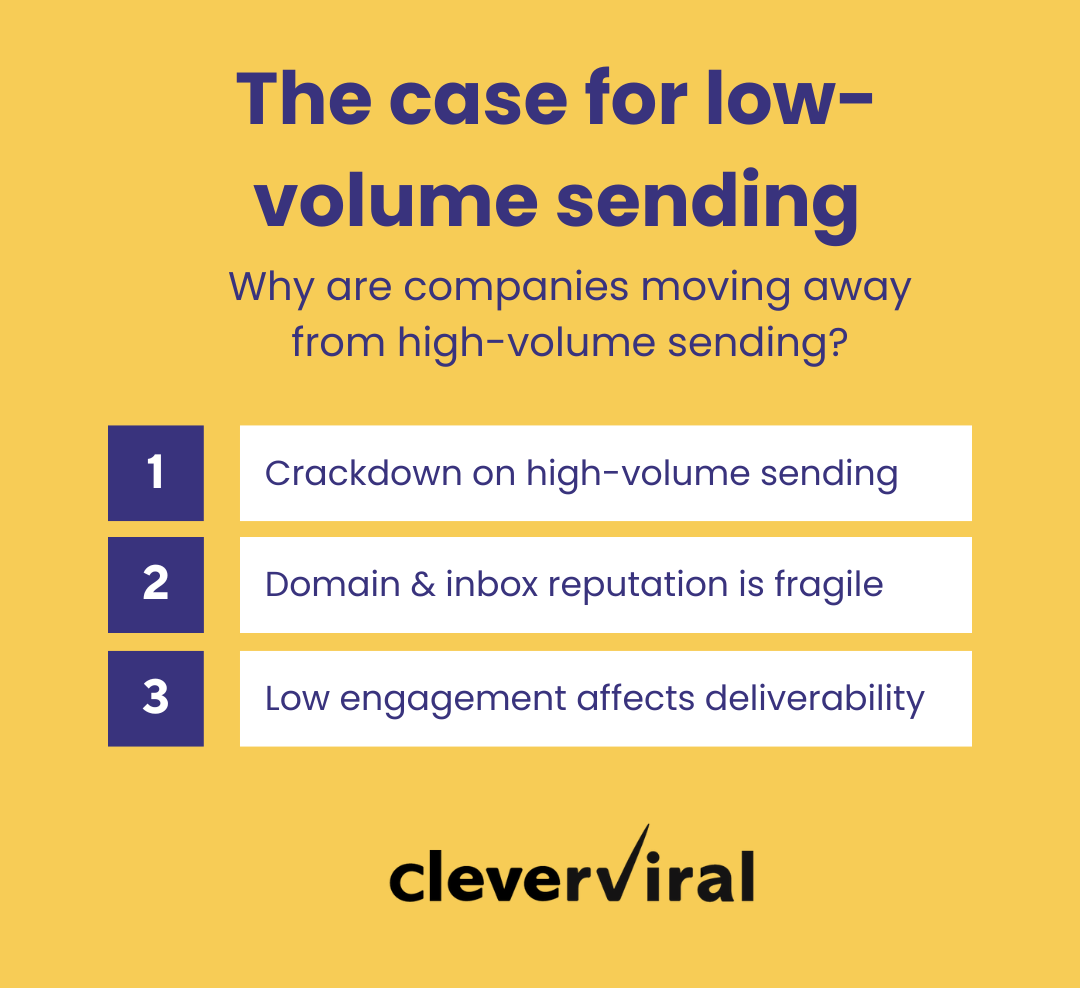
The case for adopting low volume sending as a key outreach strategy can be traced back to the early days of cold emailing – where it was nothing more than a numbers game.
The idea was simple:
→ Send 1000s of emails
→ Get a handful of replies
→ Close a few deals & make bank.
But as we approach an era of AI-powered cold emailing, this strategy is far from effective.
There are several reasons behind this development, with some of them covered below:
Spam filters have become more advanced, tracking not just email content but also sending behavior. If an email provider (like Google or Outlook) notices an inbox sending hundreds or thousands of emails daily, it raises a red flag.
👉 Why? Spammers do the same thing.
Email providers group high-volume senders with spammers, tanking their domain reputation and pushing emails to spam. A good start to avoid this is by keeping your daily sending under 50 per inbox, so you maintain a healthy volume and domain reputation while still flying under the radar.
Your domain has a reputation score that affects whether your emails get delivered. If too many emails from your domain are marked as spam, all future emails from that domain are at risk.
Moreover, with your individual inbox also having a reputation, sending too many emails too quickly can lead to the inboxes getting flagged (or even worse, blacklisted!), thereby reducing the ability to reach a higher number of prospects.
With the high volume sending aspect into play, it often leads to lower engagement rates (these numbers usually read something like: Open rates below 30% and reply rate under 1%). When recipients ignore or mark your email as spam, it sends a signal to the email service provider (ESP) that your emails might be unwanted, which further impacts the email's deliverability.
As is clear, ESPs are becoming more & more stringent with the frequency and content of your emails to determine their optimal inbox placement.
As a cold emailer or SDR, low volume sending presents a rather simple (and highly-effective) solution. Instead of sending 100s or thousands of emails per inbox per day, low volume sending follows a controlled, highly targeted approach.
This is what it usually looks like:
👍Send only 30 to 50 emails per day per inbox
👍 Use multiple domains & inboxes to scale horizontally instead of blasting 1000s of emails from a single domain
👍Ensure that every email’s content is hyper-personalized to avoid spam filters
👍Keep reply rates high to maintain strong sender reputation
The impact?:
✅ Better deliverability with email sending volume that bypasses spam filters
✅ Higher engagement rates with hyper-personalized, well-timed emails
✅ Stronger domain reputation that leads to higher engagement & low spam complaints
✅Long-term scalability without burning through a domain in 2 months & helping you increase your sending volume gradually over time.
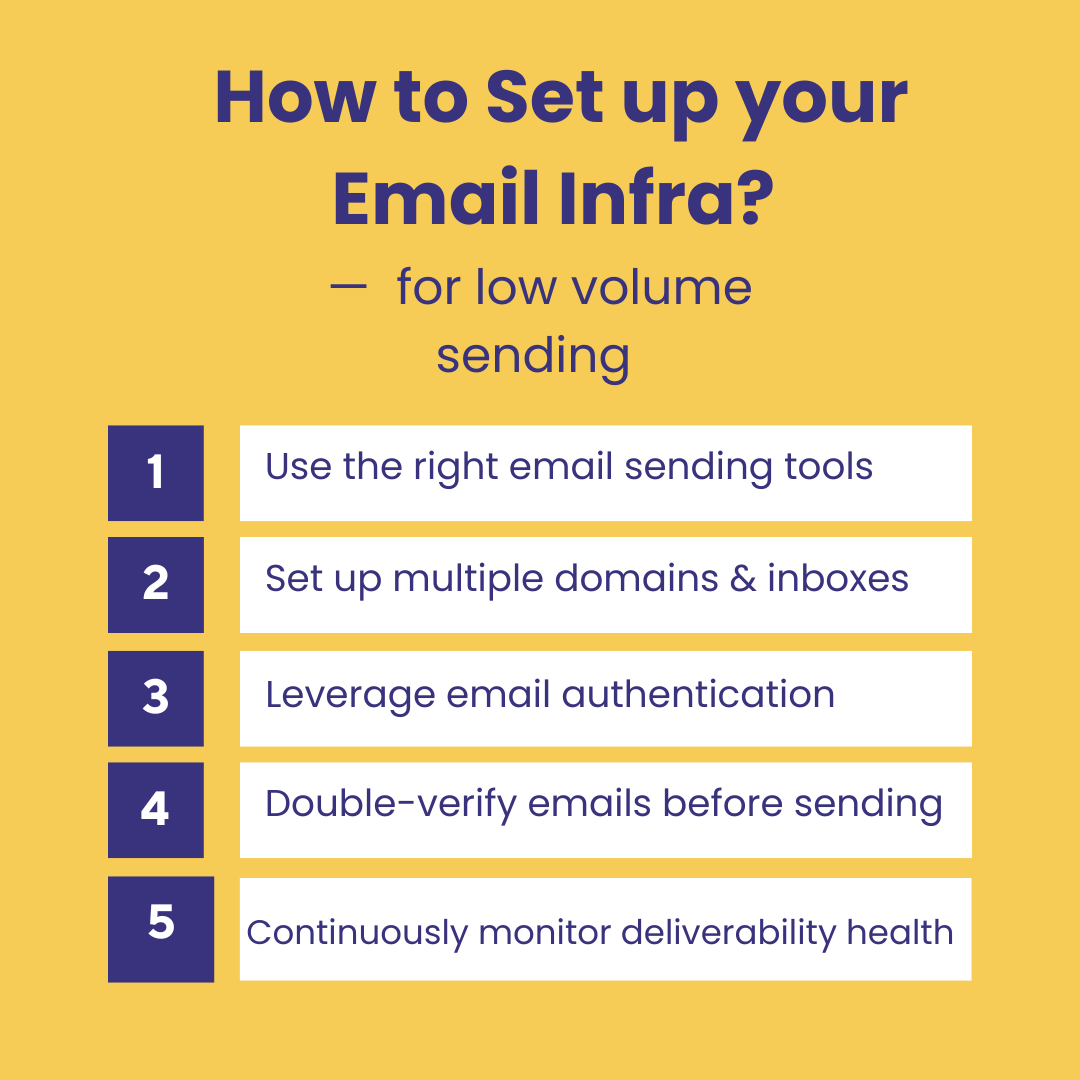
Switching to low volume cold email campaigns isn't just about sending fewer emails—it requires rethinking your entire email infrastructure. Without the right setup, even a low sending volume can land you in spam.
Below is a comprehensive breakdown of what you need to successfully implement low volume sending in your campaigns while ensuring high deliverability and response rates.
One of the biggest mistakes companies make is using marketing automation tools like Mailchimp or Constant Contact for cold email.
These platforms use shared SMTP servers, which means if another user triggers spam filters, your emails could be affected. Additionally, they throttle email volume, which can impact email sending volume and lower deliverability.
Alternatively, you should use cold email platforms like Instantly or Smartlead to set up your low volume sending infrastructure – both of which allow controlled sending & direct integration with email providers like Google and Outlook.
But why Google and Outlook?
Well, simply because Google Workspace lets you send anywhere between 30-50 emails per day per inbox – a number that you can gradually increase while also reducing the initial risk of getting flagged for spam.
The second step in optimizing your email infrastructure for low volume sending requires you to set up multiple domains and inboxes. In order to do this, you need to follow the below steps diligently:
Also, before you send out a single cold email, make sure to warm up the domain for about 3 to 4 weeks – gradually increasing the number of emails sent daily, while also optimzing the campaigns for better open rates and replies, gradually building trust with your email provider.
The third step to optimizing for low volume sending requires cold emailers to leverage email authentication protocols like SPF, DKIM and DMARC. This is done in order to ensure your emails aren’t flagged for spam or outrightly rejected by the spam gods.
To do this, you must:
Failing to follow the above steps might lead to your emails getting rejected even before they reach the prospect’s inbox, or getting flagged as a phishing attempt (or spam) by Google or Outlook, even when your email content is on-point.
Even with low volume sending, ensuring your emails reach valid inboxes is critical. Sending emails to invalid or inactive addresses not only results in high bounce rates but also signals to email providers that you’re not maintaining a clean sender list.
This damages your domain reputation, leading to lower inbox placement and more emails flagged as spam.
Validating your emails is crucial, since it:
To this end, using email validation tools ensures you’re only sending to real, active inboxes. You can use the likes of Instantly Email Verifier, NeverBounce or Apollo, Kitt and LeadMagic to verify the accuracy of prospects’ emails.
These tools usually perform the following checks before passing a prospect’s email as “optimal for sending”:
1️⃣ Syntax Check – Ensures the email address is correctly formatted (e.g., no typos like john.doe@@company.com).
2️⃣ Domain & MX Record Check – Confirms that the domain exists and has a mail server set up to receive emails.
3️⃣ SMTP Ping – Checks if the inbox is active by simulating an email sent without actually delivering a message.
4️⃣ Catch-All Detection – Identifies domains that accept all emails, even if the inbox doesn’t exist. These can lead to soft bounces, which over time hurt deliverability.
5️⃣ Spam Trap Detection – Flags email addresses associated with spam trap databases, ensuring you don’t send to addresses that could blacklist your domain.
As a pro-tip, you should avoid sending emails to catch-all domains unless they’re double-verified.
The reason?
Well, some domains are configured to accept all incoming emails even if the inbox doesn’t exist. While this seems harmless at the surface level, the catch-all domains can cause a higher bounce rate when the ESPs later reject undeliverable emails.
By implementing strict email verification practices, you not only protect your domain reputation but also increase deliverability and response rates, making your low volume sending for your campaigns far more effective.
Even with low volume cold email campaigns, you must continuously monitor performance to ensure high deliverability. Here’s a quick low-down of key deliverability metrics to watch:
You can also a bunch of tools (some of which are given below) to keep tabs on the deliverability health of your cold email campaigns:
In such a scenario, if the open and reply rates drop, you can choose to rotate inboxes and switch domains, or optimize your email copy for no spam triggers.
Additionally, you can also perform double email verification to remove inactive contacts.
Now that you know how to optimize your email infrastructure for low-volume sending, here are a few best practices to follow:
You must also segment your outreach based on the engagement levels (using low volume sending for brand-new contacts & prioritizing engaged recipients for follow-ups) to ensure your campaigns are on track & getting the desired results.
Cold email in 2025 is no longer a volume game. The spray-and-pray approach is dying, and high volume sending now leads to lower engagement and worse deliverability.
Instead, the future belongs to email marketers who master low volume sending — prioritizing high-quality, validated leads and ensuring their email infrastructure is airtight.
By focusing on quality over quantity, businesses can future-proof their outreach & drive higher engagement & conversions.
Now, you can do this yourself or engage with a trusted deliverability & cold email expert agency like Cleverviral. We can help you optimize your cold email systems for better deliverability, while also ensuring that key best practices for both high and low volume sending are followed optimally.
To know more about how we can help, drop us a line on hi@cleverviral.co or simply book a call with us!
Until then, happy prospecting!
Apply below. If we're a fit, we run a real pilot on your ICP and show you the actual replies before you commit to anything.
Apply for a free POC →