Top 12 Website Visitor Identification Tools for Intent-Based Outreach in 2025
Looking to convert website visitors into paying customers? Check out our list of the top 12 website visitor identification tools for intent based outreach at scale.
Cleverviral
·
January 14, 2025
·
16 min
Over the last couple of years, inbound-led outbound strategies have gained massive traction, owing to the fact that they usually tap into audiences that are already interested in your product or service. Every visitor that lands on your website (doesn’t matter if they’re checking out case studies, exploring pricing or reading blogs) – leaves behind intent signals.
Such signals are a goldmine for B2B sales teams that want to engage high-quality prospects. That’s exactly where website visitor identification tools come into play.
They go beyond traditional analytics, helping you identify anonymous visitors, reveal company names & track behavior patterns on your website. All of this gives you a massive head-start with intent-based outbound campaigns that give you a 28% higher conversion rate.
But how do you choose the right tool for your business? This article explores 12 of the best visitor identification software tools in the market currently.
Designed to help you identify high-intent prospects & scale your outreach, here’s everything you need to know about them:
What are Website Visitor Identification Tools?
At their core, website visitor identification tools help businesses track and identify visitors who land on their website. These tools go beyond basic analytics by identifying anonymous visitors, often providing details like company names, visitor behavior, and contact information. For B2B businesses, this means uncovering valuable intent signals from prospects actively seeking your solutions.
For instance, when a prospect visits your pricing or case studies page, it’s a clear indicator of interest. Armed with this data, your team can tailor outreach to address their specific needs, turning cold leads into warm conversations.
That being said, the following scenarios further explain the use case for such tools in your B2B sales process:
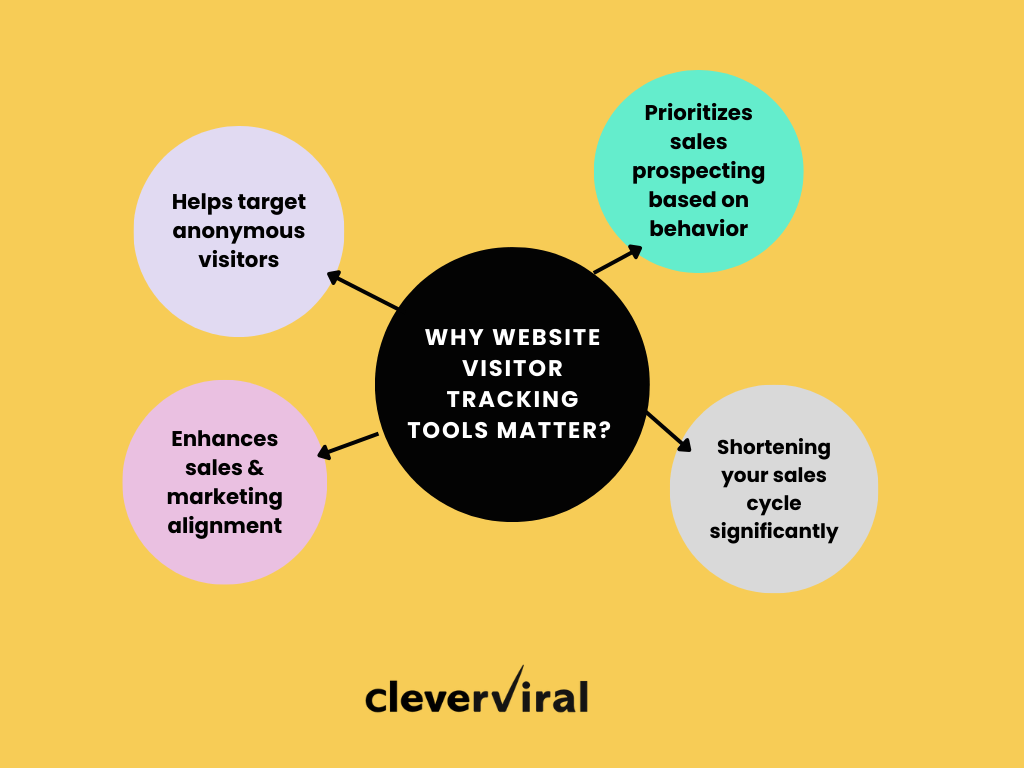
1. Targeting Anonymous Visitors
Traditional analytics tools like Google Analytics can tell you the number of visitors your website receives, but they often fail to provide specifics about who these visitors are. That’s where anonymous website visitor identification tools step in, uncovering insights such as the company name, location, and even industry of your visitors.
This is a game-changer for B2B outreach because studies show that 98% of website visitors leave without filling out a form. Without a mechanism to identify them, you could be losing out on potential leads daily.
With B2B website visitor identification tools, you gain the ability to connect with prospects who are already expressing interest through their site activity—people who might never complete a form or initiate contact on their own.
This not only amplifies your lead pool but also ensures you’re engaging prospects who are actively exploring solutions like yours.
2. Prioritizing sales efforts based on behavior
Not all website visitors have the same level of interest or intent. Some may land on your blog by accident, while others are actively scouring your pricing page or downloading case studies. Website visitor tracking tools analyze visitor behavior—such as pages viewed, time spent, and actions taken—and assign lead scores to prioritize high-intent prospects.
For example, a visitor who spends time on your demo page is likely further along in their buying journey than someone skimming a general blog post.
According to a report by Forrester, businesses using intent-based prioritization tools see a 37% improvement in sales productivity because their teams can focus on the most promising leads.
With insights from these tools, your sales team can channel their energy into prospects most likely to convert, reducing wasted effort and boosting ROI.
3. Enhancing sales and marketing alignment
Misaligned sales and marketing teams are a common roadblock in many organizations. However, with website visitor identification tools, both teams can operate from the same playbook, informed by real-time visitor insights. Marketing can design campaigns targeting high-intent visitors, while sales teams receive actionable data, such as visitor behavior and firmographic details, for more personalized outreach.
For example, if the marketing team identifies a surge of visits from companies in the healthcare sector, they can create content tailored to that industry, while sales teams can craft outreach emails addressing healthcare-specific pain points.
Research from HubSpot reveals that companies with aligned sales and marketing teams achieve a 67% higher closing rate. These tools bridge the gap, ensuring that both teams work collaboratively toward shared goals.
4. Shortening the sales cycle
The longer the sales cycle, the higher the risk of losing leads to competitors or disengagement. By identifying high-intent visitors early in their journey, website visitor identification tools empower sales teams to act quickly and effectively.
For instance, knowing that a prospect has spent significant time on your pricing page allows you to craft a targeted pitch addressing their specific needs without the typical back-and-forth of qualification.
According to McKinsey, companies using intent data to inform their sales strategies reduce their sales cycle by up to 30%.
With detailed insights from anonymous website visitor identification, sales reps can enter conversations with a deep understanding of the prospect’s interests and challenges, fostering trust and speeding up decision-making.
Are website visitor identification tools GDPR-compliant?
Although website visitor tracking is legal, strict privacy regulations govern its use to protect user data and prevent misuse. To ensure compliance, businesses must focus on the following:
1. Transparency in data collection
Being transparent about the type of data you collect—such as IP addresses, pages visited, and contact details—is critical. Ensure your website’s privacy policy clearly outlines:
How will it be used, e.g., for lead generation or personalization?
Who will have access to the data, including third-party processors?
2. Obtaining user consent
Consent is a cornerstone of data privacy laws like GDPR and CCPA. Websites must notify users through cookie banners, providing options to accept or reject tracking.
In addition, you can also customize the cookie settings to align with legal requirements and user preferences.
3. Avoiding data misuse
Misusing visitor data for irrelevant or unsolicited outreach can harm your reputation. Overloading prospects with generic emails risks spam complaints, lowered deliverability, and blacklisting.
You must also focus on using intent-based data responsibly to maintain credibility.
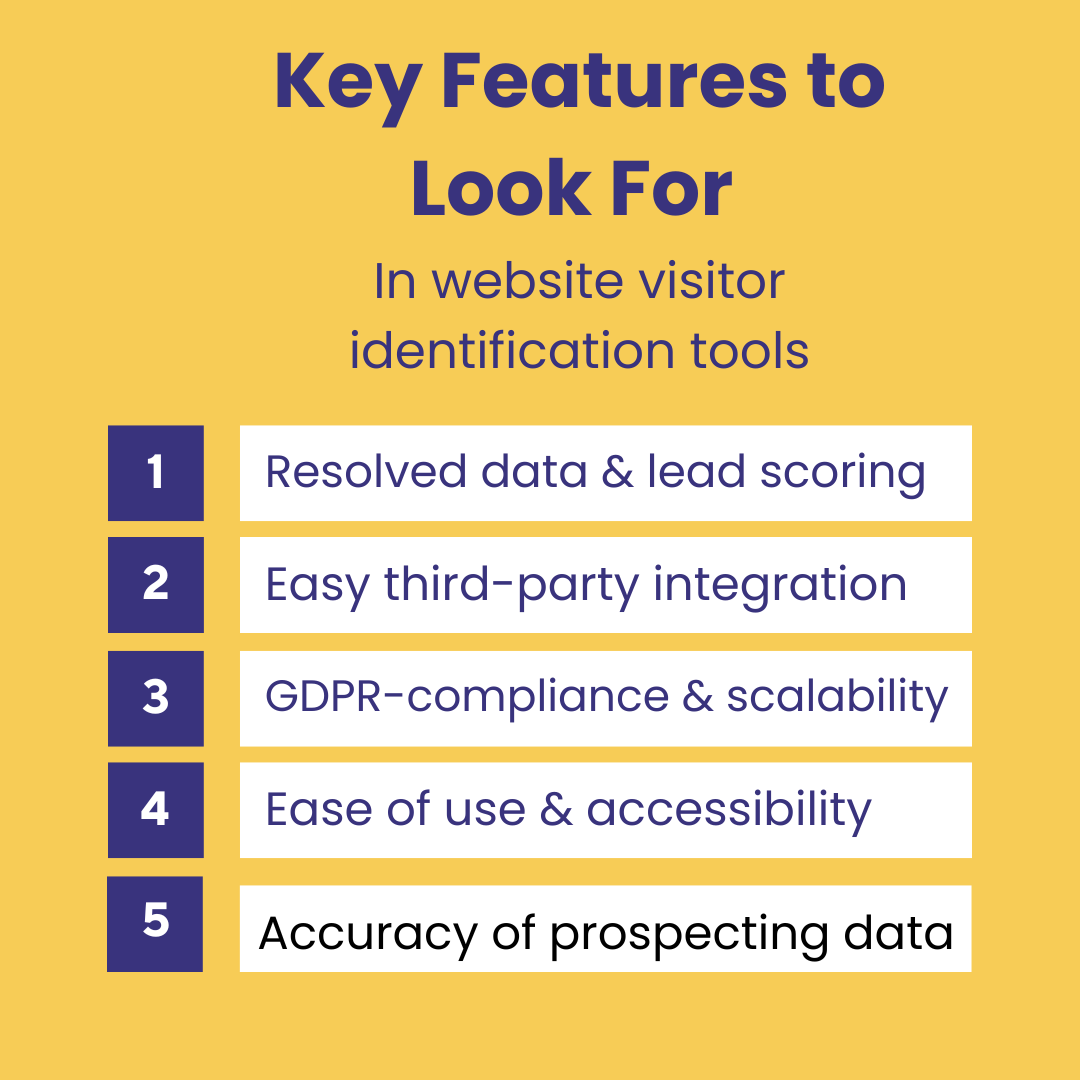
Key Features for Website Visitor Identification Tools
When evaluating the best visitor identification software, it’s crucial to consider features that directly impact your outreach success.
Below are the must-have capabilities:
1. Resolved data & lead scoring
Visitor identification tools should provide detailed, actionable insights like company names, decision-makers, and engagement levels.
They must also offer lead scoring capabilities to further refine this data by ranking prospects based on their likelihood to convert – enabling your team to focus on high-value opportunities.
2. Easy integration with CRM & other tools
For optimal efficiency, your website visitor tracking solution must integrate seamlessly with your existing CRM systems like Salesforce, HubSpot, or Zoho. This integration ensures that visitor data is automatically funneled into your CRM, allowing your sales and marketing teams to work from a unified database without manual data entry.
When data flows seamlessly, your sales team can instantly access prospect insights, reducing delays in follow-ups. Research by Nucleus found that companies integrating their CRM with such applications see a 20-25% boost in sales productivity.
Additionally, integration with email marketing tools or marketing automation software enables personalized, intent-driven campaigns triggered directly from your visitor data. This ensures that no lead slips through the cracks, optimizing your outreach efforts.
3. Compliance with privacy laws
Compliance with data privacy regulations like GDPR and CCPA is non-negotiable. The best visitor identification software incorporates features like cookie banners, built-in consent mechanisms, and clear data usage policies to ensure you’re collecting information responsibly.
As a business, you must look for software that offers customizable cookie banners, allowing users to opt in or out of tracking.
These features not only protect your business but also build trust with your prospects by demonstrating transparency.
4. Ease of use & accessibility
No matter how powerful a tool is, it’s only effective if your team can use it efficiently. A user-friendly interface and intuitive design are crucial for widespread adoption across your sales and marketing teams.
There are several tools that prioritize ease of use by offering clean, dashboard-style interfaces that require minimal training. Accessibility also matters; which is where opting for cloud-based solutions ensures that your team can access critical data anytime and anywhere.
You must also look for providers that offer robust customer support, including tutorials, FAQs, and live chat assistance, so as to leverage the tool to its full potential.
5. Data accuracy
Accurate data is the cornerstone of effective website visitor identification. Outdated or incorrect information can lead to wasted effort, as your team may chase irrelevant or non-existent leads. The best visitor identification software relies on real-time data collection and robust verification mechanisms to ensure precision.
Several tools in the market also leverage advanced IP tracking and cross-referencing with updated databases to deliver accurate results. By investing in tools with proven accuracy, you not only save time and resources, but it also boosts conversion rates by ensuring your outreach targets the right people.
6. Pricing & scalability
Scalability is a key consideration, especially for growing businesses. The ideal anonymous website visitor identification tool should offer flexible pricing models that cater to startups and enterprises alike. For instance, some tools operate on a pay-per-lead basis, while others offer subscription tiers based on usage volume.
ZoomInfo, for example, provides scalable plans that grow with your needs, ensuring that you’re only paying for what you use. Affordability is crucial, but it should never come at the expense of quality.
Moreover, the likes of Ocean.io and Clay also help optimize costs by focusing only on high-intent visitors, ensuring every credit spent translates into value.
All in all, by focusing on these key features, companies can ensure that their choice of website visitor identification tool is both effective and efficient; setting you up for better conversions and higher ROI.
12 Best Website Visitor Identification Tools for 2025 – [Comprehensive Review]
Now that you’ve got a complete view of key features to look out for, it's time to look at the options available in the market. Many of these website visitor identification tools offer a robust set of features that’ll power your outreach & help you scale further.
So what are these options? And what can you expect? Let’s take a look:
1. RB2B
Retention B2B (or RB2B as it is popularly called) is amongst the top website visitor identification tools in the market. Their offering makes it easy for you to start tracking visitors on your website. The best part? You get notified of a new visitor right inside your Slack, which makes it easy to keep track of all the new prospects you might want to target.
In addition to insights like the prospect’s full name, LinkedIn profile, company name and location, they also offer data in the form of web cookies, behavioral analytics and IP address tracking among others.
Pros:
Integrates with various CRM systems including Slack, Clay, Apollo, Smartlead and Zapier.
Easy to configure, doesn’t require extensive technical knowledge to set up and run.
Offers real-time information about new website visitors
You can use RB2B to retarget visitors from key subpages on your website.
Cons:
Offers tracking for US-based visitors only, which can be detrimental if you serve clients in the European and Asian markets.
Offers credit-based pricing, which can lead to instances of ‘false positives’ using up your credits, leading to quick exhaustion.
While the free offering is useful, it's still limited in features. Switching to the paid plan causes a significant jump in expenses – making it less ideal for early-stage businesses.
2. Zoominfo
ZoomInfo’s website visitor identification tool is a powerful resource for B2B businesses looking to turn website traffic into actionable leads. By providing detailed insights into who is visiting your site, this website visitor tracking solution enables sales and marketing teams to identify and engage high-intent prospects effectively.
What sets ZoomInfo apart is its ability to uncover the identity of anonymous website visitors, turning otherwise missed opportunities into meaningful connections.
It integrates seamlessly with CRMs, offering a streamlined way to leverage visitor data for personalized outreach and account-based marketing strategies.
Pros:
You can automatically create leads from website visitors – allowing your sales team to follow-up with them instantly.
Offers instant integration with third-party CRM systems so you can view all potential prospects in a single place.
Provides information about which pages visitors viewed, how long they stayed on the site, and other valuable data to understand their level of interest.
Cons:
Their expensive pricing is detrimental for smaller businesses, making it difficult for them to leverage the tool’s full potential.
The user interface is a little complex, and may require a certain learning curve to use the tool effectively.
The data accuracy is a challenge, since the tool’s database might not have latest, up-to-date prospect data.
3. Albacross
Albacross is amongst the top, up-and-coming website visitor identification tools in the market today. It helps users convert website visitors into potential customers by gathering comprehensive business and prospect information for your outreach.
As a user, one can filter out companies and visitors based on the size, industry, country and other variables. Focused on the EU market, you can also integrate the tool with your CRM and content management systems.
In addition to analyzing how visitors interact with your website content, you can also enrich your visitor data with detailed information for prospecting.
Pros:
Offers actionable intent data that can be extremely useful for your outreach.
The data enrichment and visitor tracking capabilities are GDPR-compliant.
The tool also offers AI-powered lead scoring capabilities to prioritize which prospects to reach out to.
Cons:
Offers limited data coverage.
As per a few users, the tool is priced a little on the higher side – so as to ensure price to functionality and effect ratio is maintained.
While some companies have extensive amounts of data available, others often lack on this front, leading to imbalance in data availability.
4. HubSpot Sales Hub
If you're looking for website visitor identification tools that help you uncover who's browsing your site and turn those visits into leads, HubSpot's Sales Hub might just be the tool for you. It’s designed to track and analyze visitor activity, making anonymous visitor identification easier and more actionable.
Imagine getting real-time notifications when a potential prospect lands on your site—giving you the perfect opportunity to engage them with personalized outreach.
What makes HubSpot’s Sales Hub stand out is how seamlessly it integrates with its broader CRM platform. Everything is connected, so you have a full view of your leads’ journey—from their first click to their last interaction.
If aligning your sales and marketing efforts while gaining deeper insights into your visitors sounds like what you need, HubSpot’s solution might be worth exploring.
Pros:
The tool works effortlessly with HubSpot’s CRM, giving a unified view of leads and their journey.
Real-time notifications alert the sales team instantly whenever a new prospect visits your website – enabling timely outreach.
HubSpot’s website visitor identification tools automatically rank visitors based on their activity and intent, helping your team focus on high-value prospects.
Cons:
Advanced features can be pricey, especially for small businesses or startups with limited budgets.
The tool may lack advanced customization for businesses with highly complex sales processes.
While the tool is effective, it might not identify all visitors, especially those with strict privacy settings or ad-blockers.
5. Lead Forensics
Lead Forensics is another renowned name on our list of anonymous website visitor identification tools. The solution offers real-time visitor alerts which helps you understand what pages prospects are hopping on – using it to power your outreach.
In addition to this, they also offer data enrichment capabilities to enrich visitor information, while their customizable dashboards give you a bird’s eye view of prospective visitors on your websites.
Pros:
Lead Forensics offers easy CRM integration features, ensuring seamless flow of prospect information between sales and marketing teams.
Similar to other website visitor tracking tools, Lead Forensics also offers real-time data on prospects visiting your website.
The tool leverages IP tracking to identify decision makers at companies visiting your website.
Cons:
Lack of transparency in pricing can be a detrimental factor for some users.
The IP to company data is sometimes inaccurate, translating into some companies not being part of the database at all.
Some users have reported the absence of additional filters on the location, which prevents them from picking specific states within the country they’re looking for.
6. Instantly AI Website Visitor Identification
Apart from its wildly-popular email sending software, Instantly also offers a website visitor tracking tool powered by AI. To do so, you simply need to install the pixel and the tool will start gathering insights about the visitors under the “Website Visitors” tab. Once that’s done, you can also filter leads based on criteria like revenue, roles and department among others.
Instantly also has in-built functionality to check for duplicates & to verify emails. Moreover, you can also add the visitors to your next outreach campaign by clicking on the “Add to Campaign” option.
Pros:
You can easily integrate the tool with your Slack, so you get fresh updates as soon as a new visitor lands on your website.
Instantly’s website visitor identification tool offers resolved data – implying that leads are verified and enriched at scale.
You can get a 360-degree view of site visitors: including their contact information, LinkedIn profiles and company data for personalized outreach at scale.
Cons:
While the software offers detailed visitor data, its accuracy may vary, thereby impacting lead quality.
New users might require time to fully understand and utilize all features effectively.
7. 6Sense
6Sense offers an AI-powered website visitor identification tool that combines B2B data and intent signals for automating sales team’s ABM workflows. The solution leverages AI to analyze visitor behavior and also predict buyer intent, which helps you understand what your anonymous visitors are interested in.
You can also prioritize leads to reach out to, identifying the ones who are currently in the market for your product or service.
Pros:
Based on user feedback, some of them mentioned how 6Sense delivered mostly accurate buyer intent and website visitor data – although with their own limitations.
The tool has seamless integration with CRMs like HubSpot, Salesforce and Google Analytics among others.
The company offers extensive customer support, which leads to seamless onboarding for new users.
Cons:
While the software’s UI is mostly smooth, the learning curve with 6Sense can be a bit steep – simply because of the amount of data on offer.
Getting a clear understanding of 6Sense’s pricing can be difficult – especially since it's based on the given company’s use cases, number of users onboard and the amount of data being consumed. This can be frustrating for users who favor standard pricing for their software purchases.
According to some users, the data refresh rate for 6Sense AI is relatively slow.
8. Warmly
Unlike other website visitor identification tools, Warmly positions itself as a “signal-based revenue orchestration platform” that not only helps you identify visitors on your website, but also find granular insights around the B2B and intent data at your disposal.
In addition, you can also build sales workflows inside the tool so that you don’t miss out on the leads coming through. Apart from this, users can also enrich their anonymous visitor identification data with more information (including demographic, firmographic, technographic and other insights).
Pros:
Warmly leverages intent signals to ensure you’re not missing out on high-intent leads and can engage with them while they’re still in the market for your product or service.
You can automate your outreach inside the tool. Whenever a visitor takes a specific high-intent action on your website, Warmly can send a personalized email or LinkedIn message to the prospect.
The tool integrates seamlessly with third-party software like Slack, Apollo, LinkedIn and HubSpot.
Cons:
Offers annual plans only, which can be detrimental for users inclined towards monthly subscriptions or use case-based pricing.
Some users have complained about the accuracy of data being a concern while using Warmly.
9. Factors.ai
Factors.ai is one of the most popular website visitor identification tools for teams to discover, qualify and reach out to anonymous users and companies landing on their website.
Thanks to Factors’ powerful intent capture capabilities, users can analyze and attribute user intent across different touchpoints to optimize their outreach. The solution also tracks account-level website behavior right through the buyer’s journey
Pros:
The tool offers multi-touch attribution that combines with your CRM to map the entire customer journey at the account level. It also lets users make data-driven decisions by comparing insights from different attribution models and filter out data based on win rates and deal size among others.
Offers seamless integration with Meta ads, HubSpot, Salesforce and Marketo among others.
Factors.ai also gives you insights on granular metrics and website events, helping you analyze things like scroll-depth, auto-button captures and time spent per page for more personalized outreach.
Cons:
Factors.ai doesn’t offer contact-level enrichment & you might need to leverage other third-party tools for data enrichment.
Some users have complained how the tool fails to uncover the promised “60-70% traffic” on the user’s websites.
As per some users, the de-anonymization feature works better for US & Europe markets compared to India, MENA and the SEA region.
10. Koala
Koala is amongst the newest website visitor identification tools on the market offering a slew of interesting features, such as uncovering product usage data. Such insights are quite useful for identifying cross-selling and upselling opportunities, especially if you’re a SaaS or enterprise software solution.
The tool uncovers insights about website visitors, enriching them with first-party intent data. You can also automate lead scoring to prioritize high-intent accounts or leads that fit your ICP.
With a unified interface for account management, Koala can help you automate the whole intent-based outreach process at scale.
Pros:
The tool offers end-to-end product usage tracking, enabling you to not only improve the customer experience, but also automate outreach to high-intent leads at scale.
You can score leads based on intent and their fit as per your ICP, allowing sales teams to identify which accounts or prospects to reach out to.
Cons:
The tool doesn’t offer extensive sales engagement or automation options.
Koala doesn’t have 3rd-party enrichment or visitor data which can be useful insights for personalized outreach.
Most of the top features (and the most useful ones) are gated behind a paywall, which might not be ideal for companies looking to trial out the software before making a decision.
11. Vector
Vector is another really popular website visitor tracking tool that helps you uncover information about website visitors in the US who land on your website. Users can leverage Vector to access information such as the prospect’s full name, email address, company name and job title and use it to start an outreach campaign instantly.
Moreover, you can also leverage intent signals to track and prioritize high-value prospects while reaching out to them. You can even automate this process at scale using CRMs and cold email platforms like HubSpot, Clay, Apollo and Outreach among others.
While there are traffic limitations for personal profiles in the US, Vector is 100% free-to-use, making it a must try.
Pros:
Vector has an easy installation process, and takes just 5 minutes to set up the pixel and get it running.
Vector offers extensive data accuracy that helps you reach out to prospects with highly-personalized messaging that resonates.
The company offers exceptional customer support – with extensive handholding during the new user onboarding phase.
Cons:
Vector offers integrations with a limited set of tools, which could pose problems in your sales workflow. You’ll need more than 1 platform to automate your B2B sales process at scale, if you decide to choose Vector for anonymous visitor identification.
Vector offers quarterly and annual plans, which could be expensive for smaller teams and businesses.
12. Snitcher
Snitcher is another anonymous website visitor identification software that identifies companies which visit your website, leveraging extensive filtering and CRM integration to prioritize leads for outreach.
Ideal for B2B marketers and development/product teams, Snitcher offers real-time notifications for timely outreach and getting information about the prospect, alongside their company name, email address, job title and which pages they visit on your website.
Pros:
Offers high visitor identification rates, which improves how you perform outreach at scale.
Snitcher has a user-friendly interface and offers custom reporting options to highlight key insights from the data collected.
You can segment leads and filter them based on different criteria. One can also score leads based on the order of prioritization using attributes like company size, location and economic activity among others.
Cons:
Offers limited information on individual website visitors, which can lead to you missing out on potential high-value prospects.
Price is variable but the software can be costly, especially if your business generates high-traffic volume throughout the month.
Setting up the integrations can prove to be tricky, since it involves a lot of technical steps. This can lead to frustration with the platform, stalling your outreach efforts.
As is clear, choosing the right website visitor identification tool requires in-depth understanding of your own requirements, apart from the features on offer. You can consider any of the above options based on factors like your business size, use cases involved and missing parts in your outreach engine.
Keep in mind that whichever option you choose, it should serve your purpose well, while also being relatively light on your pocket.
Combining the Right Website Visitor Identification Tools with AI — The Cleverviral Way!
Choosing the right website visitor identification tools is just the beginning. To fully unlock their potential, integrating these tools with AI-driven personalization and automation is essential.
At Cleverviral, we specialize in combining insights from these tools with advanced AI systems to craft hyper-targeted outreach campaigns that deliver results.
If you’re a B2B business looking to scale your outreach with intent-based campaigns, reach out to us on hi@cleverviral.co or simply fill out the form on our website.
Frequently Asked Questions
Can you identify visitors to your website?
Yes, you can identify visitors to your website using website visitor identification tools. These tools, like HubSpot’s Sales Hub or ZoomInfo, help uncover anonymous visitor identification data by analyzing IP addresses, company details, and visitor behavior.
A good website visitor tracking solution provides insights into who’s browsing, their interests, and their activity, enabling you to engage high-intent prospects.
Can we know who visited our website?
Yes, with website visitor identification tools, you can gain insights into who visited your website.
These tools use anonymous visitor identification methods, like analyzing IP addresses and firmographic data, to identify companies or potential prospects browsing your site
Is website visitor tracking GDPR-compliant?
Yes, website visitor tracking can be GDPR compliant when used correctly. Tools that provide website visitor identification must adhere to privacy laws by collecting and processing data responsibly.
GDPR compliance requires transparency, user consent, and ensuring that any anonymous visitor identification is handled without violating personal data rights.
Implementing clear cookie consent banners and allowing users to opt out of tracking are critical steps to maintain compliance while leveraging these tools effectively.
Free POC
Reading about outbound isn't running it. Want us to run yours?
Apply below. If we're a fit, we run a real pilot on your ICP and show you the actual replies before you commit to anything.