
Outbound Workflows
Automate Lead Research (And Qualification) Using AI - Full Clay Workflow
Want to get more leads that fit your ICP at scale? Learn how you can automate lead research & qualification at scale using AI in our in-depth article.
Want to get more leads that fit your ICP at scale? Learn how you can automate lead research & qualification at scale using AI in our in-depth article.
The world of outbound sales has dramatically evolved over the past few years. As of 2025, the landscape is faster, smarter, and more data-driven than ever before. Sales teams are no longer relying on traditional methods of cold calling, manual prospecting, or leveraging outdated B2B databases.
Instead, they’ve shifted gears towards leveraging the power of sales automation, AI and hyperpersonalization to streamline every aspect of the B2B sales process. With cluttered inboxes and a rather rapid crack down on email deliverability, the need to automate lead research has moved from a "nice-to-have" to a "must-have" for modern sales teams.
With the vast amount of data available today, what’s needed is an approach that can help you automate lead research at scale, while also intelligently qualifying those leads based on real-time insights and predictive analytics.
Over the course of this article, we’ll look to understand the need to automate AI lead qualification at scale while also understanding how you can do using a scalable tool like Clay.
So let’s get started.
Before we get down to understanding the need to automate lead research, it’s crucial to understand what both of these terms really mean. In simple terms, lead research is about finding potential customers for your product or service.
Think of it like a treasure hunt—you’re digging through various sources to identify companies or individuals who might be interested in what you offer.
This could mean searching through databases, social media, company websites, or even getting referrals. The goal is to gather a list of prospects that match your Ideal Customer Profile (ICP).
On the other hand, lead qualification is the process of figuring out if a lead is really worth your time or if they’re just going to take up space in your CRM. Under this, you’re looking at specific criteria like:
All in all, lead research and qualification are crucial for your outbound success since they ensure you’re focusing your time and resources on high-potential customers, thereby maximizing conversions & minimizing wasted effort.
Now that we know what lead research and qualification are all about, let’s dive into how AI can help supercharge both of these processes.
AI is changing the game, making it easier than ever to automate lead research and qualify leads using automation and conversational intelligence.
Here’s how it all works:
When it comes to lead research, AI is a total game-changer. Traditionally, lead research involved manually sifting through endless data and websites, but with AI, everything becomes faster, more precise, and more scalable.
With AI-powered tools like Clay, you can automate data scraping to pull key information from multiple sources—websites, social media profiles, business databases—and instantly get insights into the companies and individuals you want to target.
AI can also help you analyze the data in real time, identifying which leads fit your ICP (Ideal Customer Profile) based on specific factors like company size, industry, location, and even recent activity or engagement.
On the other hand, when it comes to lead qualification, AI plays an equally important role. Instead of manually reviewing every lead to decide whether they’re worth pursuing, AI can automatically score and prioritize leads based on a set of predetermined criteria.
Using their AI lead qualification, tools like Clay analyze factors like past engagement, website behavior, company size, and more to score each lead on its potential to convert.
For example, if someone has visited your pricing page multiple times, downloaded a product brochure, and interacted with your emails, AI can recognize these actions as strong indicators that they’re a high-priority lead.
In the next few sections, we’ll dive deeper into the benefits of automating your lead research & qualification.
We shall also talk about how you can put all of this into action using Clay, setting up a powerful workflow to automate lead research & qualification at scale.
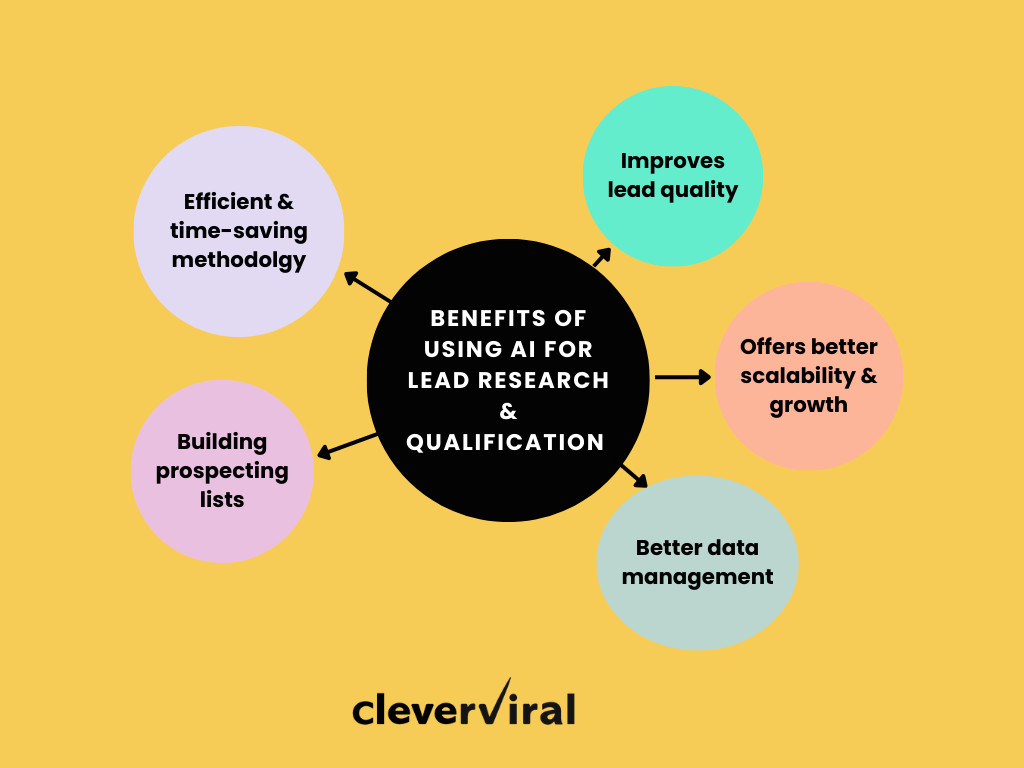
Right before we jump into the AI-powered workflow to automate lead research & qualification, let’s take a look at the various benefits it offers:
Automating lead research & qualification with AI ensures you can shift your focus from data collection and administrative tasks to actually engaging with the most promising leads .
This is where AI in lead qualification becomes a game changer – evaluating data points like engagement levels, company size, industry fit, and previous behaviors to then assign them a lead score based on these factors.
But with Clay, you can automate lead research and qualification at scale without sacrificing quality. Whether you're targeting a small market or a global audience, Clay’s AI-driven workflow allows you to handle a large influx of leads, analyze them quickly, and prioritize them based on their fit and likelihood to convert.
This scalability is especially valuable for businesses that want to expand into new markets or industries, without adding extra complexity or cost.
It automates lead research and qualification, ensuring your team always has easy access to clean, up-to-date data.
This eliminates silos and improves organization, so everyone’s on the same page.
Now that we’ve explored the need & role of AI in lead research, let’s dive into the stepwise method using which you can automate lead research & qualification at scale:
The first step to automate lead research is to scrape the company data. You can leverage Claygent to scrape this information from the company websites (depending on what type of business you are targeting), pulling in information such as:
You can provide a URL or a company name, and Clay will create a structured summary of what the company is about— which you can use for further analysis or segmentation.
The next step to automate lead research focuses on classifying the leads based on the industry or segment they belong to.
With Clay, you can create your own custom industry classifications to make sure you’re targeting the right businesses. The tool uses AI to classify each company into your predefined industries and sub-industries.
For instance, if you're focusing on healthcare companies but want to target only hospitals, Clay can segment these businesses further by sub-industry categories like Pharmacies, Medical Devices, or Family Practices.
This step helps you avoid the problem of receiving a mix of companies under a broad “Healthcare” industry when you’re only looking to target hospitals or clinics – so you can craft more targeted & highly-relevant outreach for each customer segment.
One of the most common mistakes in lead research is misclassifying leads based on their business model. For example, you might pull a list of companies that appear to fit your criteria but end up with a mix of B2B and B2C businesses. This can lead to wasted time and resources.
Thankfully, Clay can automate this process and ensure you're reaching out to the right type of business. Clay’s AI scans the descriptions and website data to determine if a business operates on a B2B or B2C model.
For example, if a company sells products specifically for other businesses (like software solutions for healthcare providers), Clay will classify it as B2B. If the business is more geared toward direct consumer sales, like a retail company, Clay will classify it as B2C.
Now that you’ve gathered all the data and classified the companies, the fourth step to automate lead research & qualification requires dialing down on leads that are worth pursuing. This is where AI lead qualification really shines.
Rather than manually evaluating each lead, you can allow Clay’s AI to score the leads for you based on a variety of factors like company size, industry fit, online behavior, and past engagement – using pre-set or custom rules for evaluation.
Based on the lead score, Clay then automatically prioritizes which leads should be contacted first. High-priority leads are flagged for immediate outreach, while lower-priority ones can be nurtured over time.
After Clay has scored and classified the leads, it can automatically send outreach emails, messages, or even ads targeting specific segments. For example, if a healthcare company with a high score is identified, Clay can automatically trigger a personalized email offering a demo or free trial.
What’s more, you can even automate follow-up messages based on the lead’s behavior or response, ensuring that you’re reaching out to them with a relevant, non-pushy message.
The final step to automate lead research and qualification lies in ensuring that your process continues to evolve. Clay’s AI doesn’t just perform one-time tasks—it can actually learn from ongoing data to help you optimize your processes over time.
As you collect more data and feedback from your outreach campaigns, Clay continuously adjusts its lead scoring and classification models, refining its approach to better suit your needs.
You can tweak your segmentation rules and lead qualification criteria based on performance, ensuring you’re always targeting the right leads.
So that’s everything you need to know about how you can leverage AI to automate lead research & scale your outbound campaigns to the next level. As a B2B business, this process involves multiple layers, which require laser-focused attention & expertise to ensure you’re getting the desired results.
While you can still do this yourself, outsourcing lead research & qualification to an expert growth partner like Cleverviral can be a game-changer. We not only help you automate the lead research process from scratch, but also craft strategies to personalize and scale your outreach for consistent results.
To know more about how we can help, simply reach out to us on hi@cleverviral.co or book a call on our website itself!
Until then, happy prospecting!
Apply below. If we're a fit, we run a real pilot on your ICP and show you the actual replies before you commit to anything.
Apply for a free test campaign →