B2B Lead Qualification Frameworks: How to Choose the Right One?
Lead qualification frameworks are useful tools that help you score, qualify and prioritize leads based on different criteria for your business. Learn how to choose the right one in our in-depth article.
Cleverviral
·
January 10, 2024
·
12 min
When generating sales for your business, capturing leads is just the first step.
In the world of B2B sales, capturing leads is just the first step. The real game-changer is lead qualification, which not only saves time but also ensures that your sales team focuses on leads with the highest conversion potential.
While finding the right prospects is time-consuming, asking the right questions and applying the appropriate lead qualification frameworks can pretty much streamline this process, making your sales outreach more efficient and targeted.
But how does one get started? And how do you really choose a lead qualification framework that works for your business?
Over the course of this article, we’ll learn about some popular B2B lead qualification frameworks, how and when to use them and a stepwise breakdown of how to create your own as well.
What are Lead Qualification Frameworks?
Lead qualification frameworks are systematic approaches used to evaluate potential customers' suitability for your product or service. These frameworks help sales teams prioritize leads based on specific criteria, ensuring that efforts are concentrated on the most promising prospects. For instance, a study by MarketingSherpa found that using structured lead qualification methods can increase the average close rate by up to 20%.
Among the numerous frameworks available, 'BANT' (Budget, Authority, Need, Timeframe) is the oldest, whereas the 'NOTE' (Need, Opportunity, Team, Effect) framework represents a more modern approach.
In the next section, we'll further explore some common lead qualification framework examples & the right way to use them for your business.
Lead Qualification Framework Examples
Different businesses require different approaches, but fortunately, there are several pre-existing lead qualification frameworks to choose from. Most of these frameworks are characterized by how they structure and prioritize their qualifying questions.
Here’s a comprehensive overview of some common lead qualification framework examples:
1. BANT
Source: Lean Labs
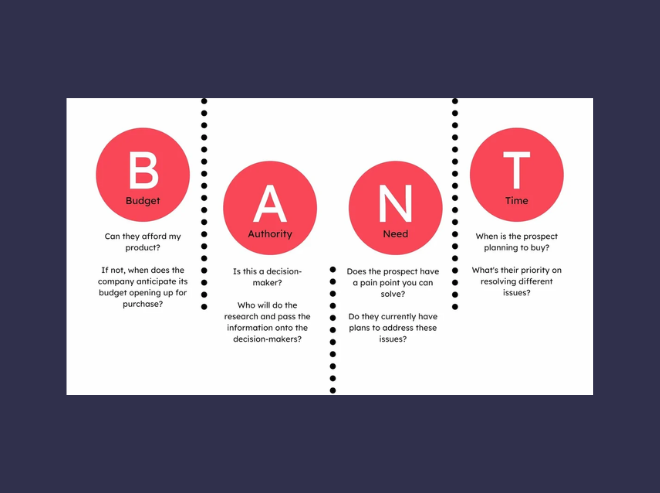
BANT, focusing on 'Budget, Authority, Need, and Timeframe' is one of the classic lead qualification frameworks, developed by IBM in the 1950s. It's particularly useful in environments where budget and decision hierarchies are key factors.
Under the ‘Budget’ section, you should be ascertaining whether the prospect can afford your product or not, apart from the amount of money they’re willing to spend.
Some common questions to ask here could be:
“Do you currently spend money on this problem?”
“Given that you’re losing ‘X’ amount/year for this problem, how is it related to the budget you’re willing to spend?”
“What are you going to lose if you don’t fix this problem?”
“You can make/save X amount of money per year through our product or service. Keeping that in mind, how does it relate to the budget you’re looking to spend?
Once you’ve ascertained the budget, identify who are the decision-makers involved and ask them the following questions:
“Have you bought a similar product previously? What was the decision-making hierarchy like?”
“Would you want to include another stakeholder/individual in the next meeting?”
Given that we’ve now ascertained the budget & decision-making process involved, it’s important to focus on the pain points or challenges the prospect wants to solve, in order to make your pitch more personalized & targeted.
Here are the related questions to ascertain the need for your product or service:
“When did you identify the problem?”
“How can solving this problem impact your business and personal goals?”
“What’s the biggest priority for you this year?”
Once the problems have been identified, it becomes easier to time your solution or offer. To ensure the same, here are a few questions for you to consider asking:
“What prompted you to look for a solution now?”
“How urgent is the problem to be solved? Are there any deadlines?”
“How soon would you want to start the engagement/installing/onboarding?”
“We’d need to finalize the agreement by {{date}}. Sounds feasible?”
If the lead matches at least 75% of the above criteria, you can consider them to be qualified for outreach.
When to Use BANT?
Using the BANT lead qualification framework is Ideal in sectors that have well-defined budget cycles and approval processes, like large corporations and government entities.
The BANT lead qualification framework for organizations with a clear decision-making hierarchy, and those that are specific about investing their time and efforts.
When to Not Use BANT?
BANT may not be suitable for leads who don’t have an exact budget in place
It’s beneficial to pitch only to prospects who know what they’ve paid for previously, and understand the value you’re adding to their business with your solution.
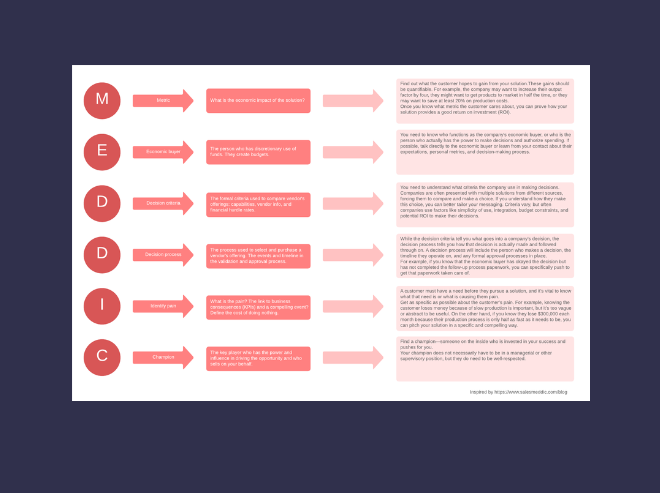
MEDDICC is the second on our list of lead qualification frameworks and stands for ‘Metrics, Economic buyer, Decision criteria, Decision process, Identify pain, Champion, and Competition’.
The MEDDICC lead qualification framework in sales was first introduced during the 1990s at the PTC software company by Jack Napoli and Dick Dunkel, and is known to increase win rates by a whopping 25%.
This is usually attributed to the framework’s focus on thorough qualification, in-depth understanding of the buyer’s journey and strategic alignment.
The process usually begins with identifying the success metrics and the economic buyer, ensuring you address the key decision-maker early on, with a tailored approach.
In addition, identifying pain points allows you to craft solution-specific pitches, post which the champions with the prospective organization facilitate buy-in for the same.
When to Use MEDDICC?
Using lead qualification frameworks like MEDDICC is ideal if you have a long sales cycle
When you’re unaware of the problems your lead wants solved, and in situations where you want to aid a shift in the prospect organization’s processes
Lead qualification frameworks like MEDDICC are also useful when you want to sell a new version of an existing solution or want buyers to purchase at a higher price.
When to Not Use MEDDICC?
In quick sales cycles
Where the buying process is straightforward and short.
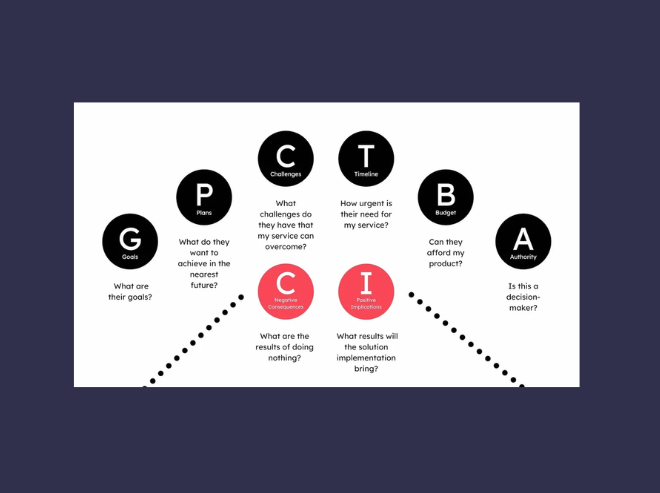
The third name on our list of the top lead qualification frameworks is the B2B-centered framework called GPCTBA/C&I by Hubspot.
Short for ‘Goals, Plans, Challenges, Timeline, Budget, Authority/Negative Consequences, and Positive Implications’, the approach is aimed at aligning your company with the prospect’s goals and resources.
Using GPCTBA/C&I provides you with a comprehensive evaluation of a prospect’s situation. It starts with understanding their goals and plans, then moves to identifying challenges.
Once the goals & challenges are identified, you’ll need to decide on an implementation timeline and factoring in the confirmed budget with approval from the decision-maker.
Using this lead qualification framework allows sales reps to be more than just sellers — and rather double up as ‘advisors’.
When to Use GPCTBA/C&I?
Ideal for businesses where sales teams have enough time & resources at their disposal.
Lead qualification frameworks like GPCTBA/C&I work well for startups and SMBs or in consultative selling environments where understanding the client's broader business objectives is crucial.
When to Not Use GPCTBA/C&I?
In transactional sales with shorter sales cycles
When the product or service has a low impact on the prospect's business strategy.
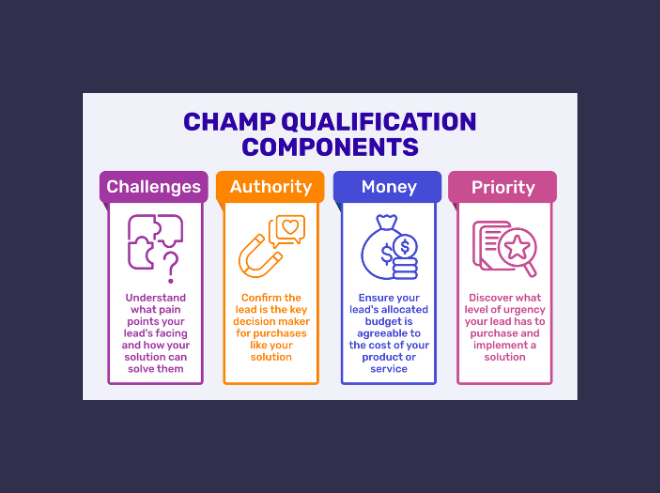
ChAMP is another of the popular lead qualification frameworks that stands for ‘Challenges, Authority, Money & Prioritization’ and puts consumer needs at the forefront of your lead qualification criteria.
Unlike other lead qualification frameworks, the approach here is to solve the problem first, and then sell your solution. The framework is ideal for modern-day service providers & focuses on combining timing with highly-relevant messaging and targeting for finding valuable leads.
When to Use ChAMP?
In environments where solving specific problems or pain points is central to the sale
Suitable for industries where customized solutions are more valued than off-the-shelf products
Suitable for sales teams at both SMBs (especially startups & SaaS businesses) and large, enterprise-scale companies.
When to Not Use ChAMP?
If you’re not confident about the ROI in terms of time & resource investment, ChAMP might not be for you, given that it’s a slower process compared to BANT and ANUM
When the product or service is a ‘nice to have’ rather than a ‘need to have’.
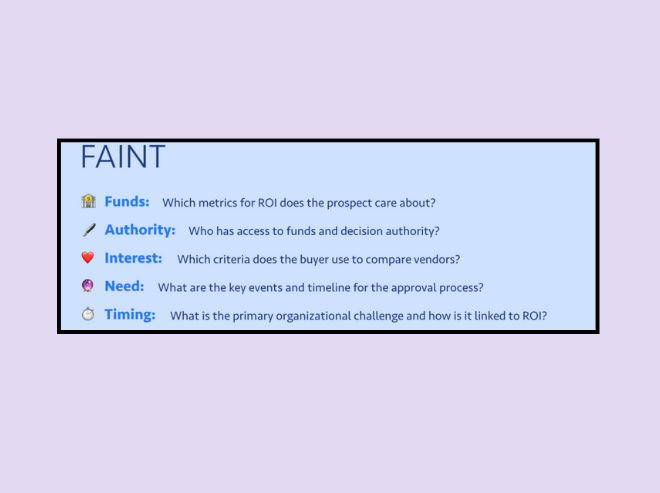
FAINT (which stands for ‘Funds, Authority, Interest, Need & Timing’) is amongst the advanced lead qualification frameworks qualifying leads based on the available funds, decision-making authority and interest in your product.
Developed by Mike Schultz of the RAIN Sales Group, it is a progression from the BANT qualification framework. The only difference here is that the latter doesn’t include any unplanned purchases (alongside the demand drivers) as per Schultz.
When to Use FAINT?
When your leads have the required budgets & spending power to invest in your solution
When your prospects are known to make unplanned purchases
When prospects don’t have a predefined budget in mind for solving the given problem.
When Not to Use FAINT?
In traditional industries with established purchasing patterns
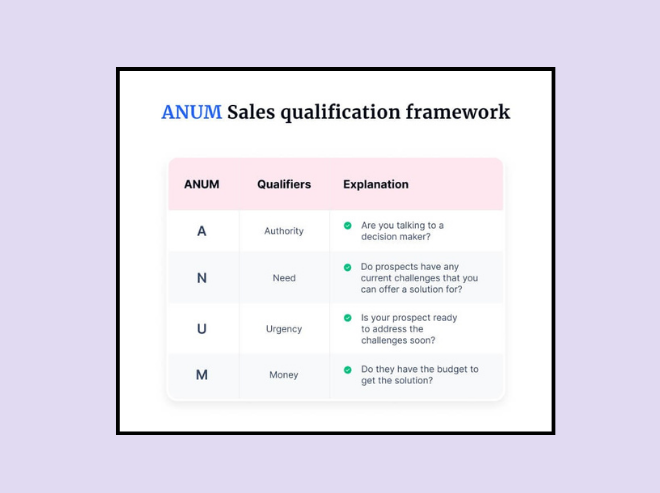
Created by Ken Krogue, the ANUM lead qualification framework uses principles of the BANT framework & gives them a modern spin to prioritize authority over the money. Short for ‘Authority, Need, Urgency and Money’, the approach is ideal in scenarios where you’re qualifying leads purely based on their roles in the decision-making process.
Unlike other lead qualification frameworks, which focus first up on the budget, ANUM qualifies prospects based on authority before moving any further – thus preventing wastage of time working on unqualified leads.
When to Use ANUM?
Ideal if you want to save time & effort on lead qualification
ANUM can be used by any company, but it is ideally-suited for larger companies with a complex, multi-step decision-making hierarchy.
When Not to Use ANUM?
If there are collaborative decision-making scenarios involved
When the purchase decision involves a long deliberation process
You might miss out on qualifying some opportunities in case the decision-maker doesn’t have the time to research solutions.
7. NOTE
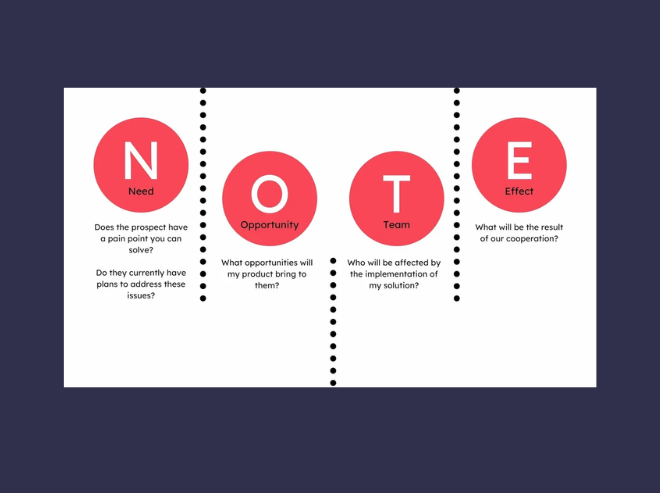
NOTE, which stands for ‘Need, Opportunity, Team and Effect’ is amongst the most popular lead qualification frameworks which determine the probability of closing deals with a given lead.
Formulated in 2016 by Sean Burke (ex-CEO, KiteDesk), the idea behind this approach/framework was to make the sales process more customer-oriented than seller-oriented.
It starts off with identifying the need for a product or service for a given lead. In case the former doesn’t align with the value proposition, the sales rep can pause all follow-ups after the first touch.
The idea here is to help the lead solve their given problem without mentioning your product or solution. Based on the need, you can then start looking for the ‘Opportunity’ where you’re analyzing the outcomes your prospects are looking to achieve with solutions currently available in the market.
Now while it's important to consider the opportunity at hand, it’s crucial to also understand if it's large enough for a prospect to put effort and time into its exploration.
Only if the answer is ‘YES’ do you move to the next step, which is centered around identifying who would benefit the most from this deal, and then follow-up with everyone on the team who’s expected to use your solution.
Once all of the above are covered, you’ll need to plug-in the measurable results that the customer will need to justify the ROI on your solution.
When to Use NOTE?
In team-based decision-making environments
When the solution has a transformative effect on the prospect’s business
When you’re looking to nurture the prospects towards a buying decision.
When Not to Use NOTE?
In individual decision-making scenarios
Where the product/service impact is limited or specific.
Once you’re familiar with the suitability of the above lead qualification frameworks, you can use the one that works best for your business, based on your goals.
How to Create Your Own Lead Qualification Frameworks? – Stepwise Process
While the existing lead qualification frameworks work pretty well in most cases, you can even create your own frameworks to make the lead qualification process easier.
That being said, most people don’t know how to go about creating their own lead qualification frameworks.
Here’s a quick stepwise guide to help you get a basic lead qualification framework up & running for your business or use case:
1. Creating buyer profiles
The first step is to start creating buyer profiles, where leads who fall outside the spectrum of your target market are disqualified. As is the case, make sure to dive deeper into the characteristics and buying patterns of your target audience.
In addition to this, you can also use demographic & business information for zeroing-in on potential leads and develop buyer personas that represent specific buyer segments you might want to reach out to.
2. Create a lead scoring model
Implementing a lead scoring model involves assigning numerical values to specific actions such as website visits, email engagement and the content downloads.
Doing this helps you prioritize leads based on their likelihood to convert, where the higher-scoring leads are targeted first, since they show a higher level of engagement and interest in your product or service.
You can also use historical customer data & insights from sales teams to craft a lead scoring system based on different purchase indicators.
3. Distinguish ‘interest’ from ‘intent’
Understanding the difference between a prospect’s interest and their intent to purchase is crucial, since it helps you separate the MQLs from the SQLs. Interest might be shown by a prospect who downloads a whitepaper, whereas intent is more likely indicated by a request for a product demo.
Make sure you nurture & target both types, in their own ways.
4. Determine the need for your solution
The next step towards creating your own lead qualification frameworks revolves around assessing how your offering fulfills a specific need of the prospects. Focus on understanding the prospect’s challenges in-depth, and accordingly align how your solution can solve them.
5. Understand the decision-making process
The typical B2B purchase decision involves about 6-10 people with the decision-making authority. When looking to create your own lead qualification frameworks, make sure you understand the following:
Who are these individuals?
What are their priorities?
How do their needs conflict or intersect with each other?
Answering the above questions will help you identify the right leads and the approach you’ll need to use to land high-stake B2B deals more efficiently.
6. Ask the right questions
Apart from understanding the decision-making process & scoring leads based on different criteria, creating your own lead qualification frameworks also requires getting accurate answers to the qualifying questions.
Although you can delve into existing data for answers, it’s a better idea to reach out to the target customers directly. Once you’ve connected them, make sure to ask the right questions.
Instead of simple yes/no queries, they often up dialogue, allowing prospects to share more nuanced, comprehensive insights about their needs & goals.
Moreover, you also need to ensure the questions are in-sync with the criteria established in your lead qualification framework & clarifies specific aspects of the qualification criteria, such as budget constraints, decision-making authority, specific pain points, or purchase timelines.
7. Capture information correctly
Ensure that the information gathered during the qualification process is accurately captured and utilized. This data is vital for refining your sales strategy and improving your qualification framework.
You can use quizzes, calculators & other such interactive content elements to prompt prospects to fill out and share their information in exchange for some free value.
Final Thoughts
So there you have it, an in-depth analysis of when and how to choose the right lead qualification framework to boost your sales success.
Remember, the key to effective lead qualification isn’t about just implementing a framework, but choosing one that aligns with your situation.
In case you have any questions or need assistance in scaling your business with the right lead generation approach, reach out to us on hi@cleverviral.co or simply fill out the contact form on our website!
Until then, happy prospecting!
Frequently Asked Questions
What is the framework for qualifying a lead?
The framework for qualifying a lead typically involves a systematic approach to evaluate a potential customer's suitability for your product or service. This process usually includes assessing factors like the prospect's budget, decision-making authority, specific needs, and the urgency of their requirement.
Lead qualification frameworks like BANT, MEDDICC, and CHAMP are commonly used to guide this evaluation, ensuring that sales efforts are focused on leads with the highest potential for conversion.
What is the first step in creating a qualification framework in lead generation?
The first step to crafting your own lead qualification frameworks involves creating buyer personas with relevant characteristics and demographic information.
Much like other sales-related processes, you need to know the ideal customer inside out to ensure you're qualifying the right kind of prospects.
Free POC
Reading about outbound isn't running it. Want us to run yours?
Apply below. If we're a fit, we run a real pilot on your ICP and show you the actual replies before you commit to anything.